Roberts Bank Terminal 2 gains national-interest status, advancing Vancouver port expansion
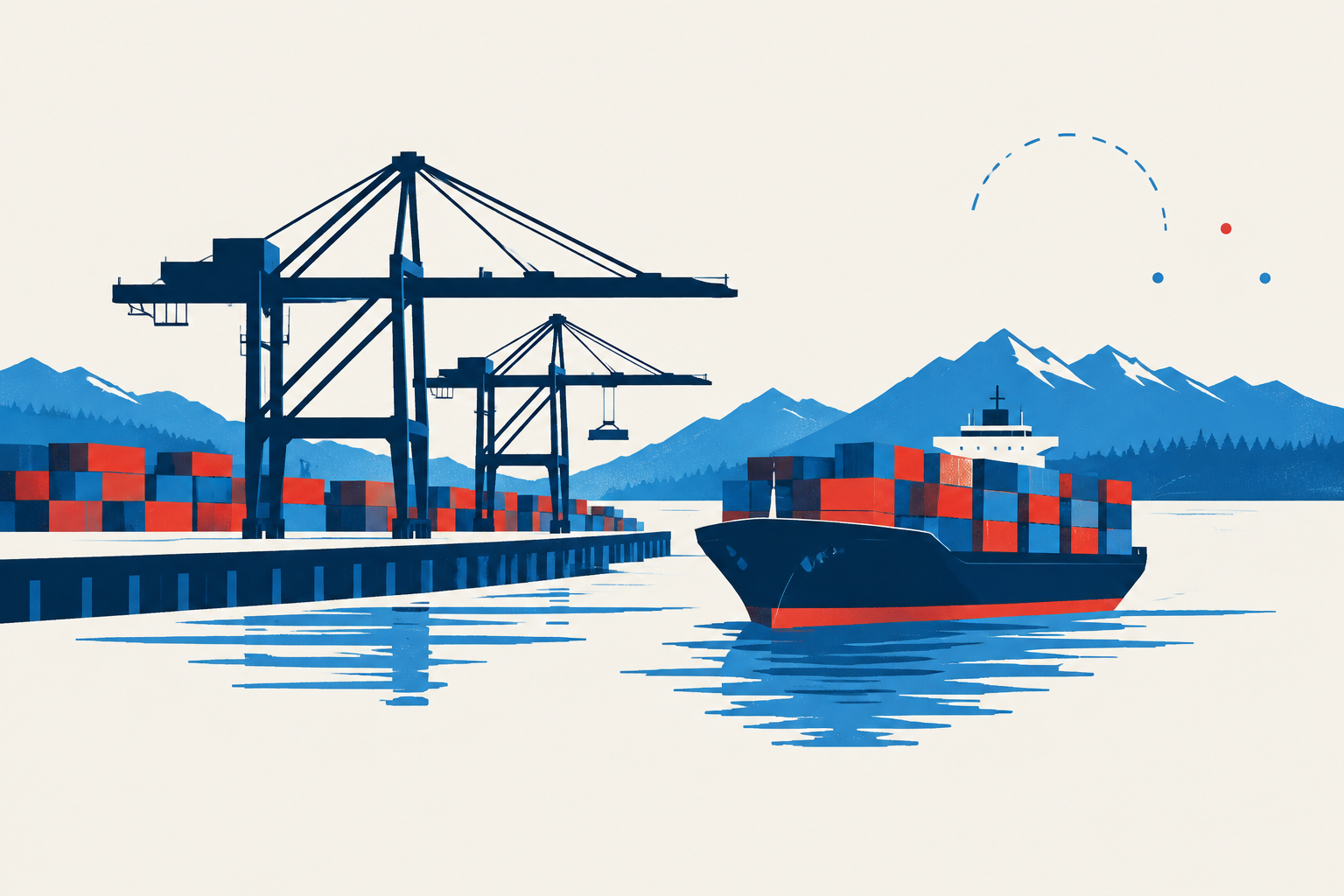
Federal designation gives the $5.9-billion terminal project added regulatory certainty and could bring major new container capacity online by 2035.
The federal government has listed Roberts Bank Terminal 2 at the Port of Vancouver as a project of national interest, a designation it says provides certainty over the remaining applicable federal regulatory authorizations. The decision is intended to move the proposed terminal toward a final investment decision by mid-2027 while retaining existing environmental-assessment conditions and providing for consultation with Indigenous communities. [1]
The Vancouver Fraser Port Authority is leading the project, which the government values at $5.9 billion. Ottawa says the designation could accelerate the start of commercial operations by up to four years, to 2035 from 2039. That timing matters for shippers and logistics operators because the government identifies forecast capacity shortfalls at the gateway as a risk to the movement of goods. [1]
If completed as described, the terminal would add 2.4 million containers of annual capacity and lift total container capacity at the Port of Vancouver by about 50 per cent. The federal release characterizes Vancouver as Canada’s largest port and its principal gateway to Indo-Pacific markets, positioning the expansion within its objective of doubling exports to non-U.S. markets by 2035. [1]
For businesses, the practical case rests on reliability and congestion. The government projects that additional capacity would improve cargo flows across Canadian supply chains and help avoid an estimated $800 million to $900 million a year in shipping and transportation costs associated with capacity constraints. These are forward-looking government estimates rather than realized savings, and the project still faces a path to final investment decision and construction. [1]
Ottawa also projects that the completed terminal could support up to $100 billion in annual trade, about $3 billion in annual GDP contribution, roughly $631 million in annual tax revenue and approximately 17,000 supply-chain jobs. The listing does not itself create those outcomes, but it removes a stated regulatory uncertainty for an export-infrastructure project that the government sees as central to diversifying trade access beyond the United States. [1]
The national-interest listing is a significant implementation step because it provides regulatory certainty for a proposed $5.9-billion expansion at Canada’s largest port and could advance commercial operations to 2035. Its exposure is economy-wide—particularly for container shippers, importers and logistics providers—but the rating is not higher because the release describes projected benefits and a prospective final investment decision, not a completed operating terminal or realized cost reductions. [1]