Tesla Emerges as Early Beneficiary of Canada’s China EV Import Quota
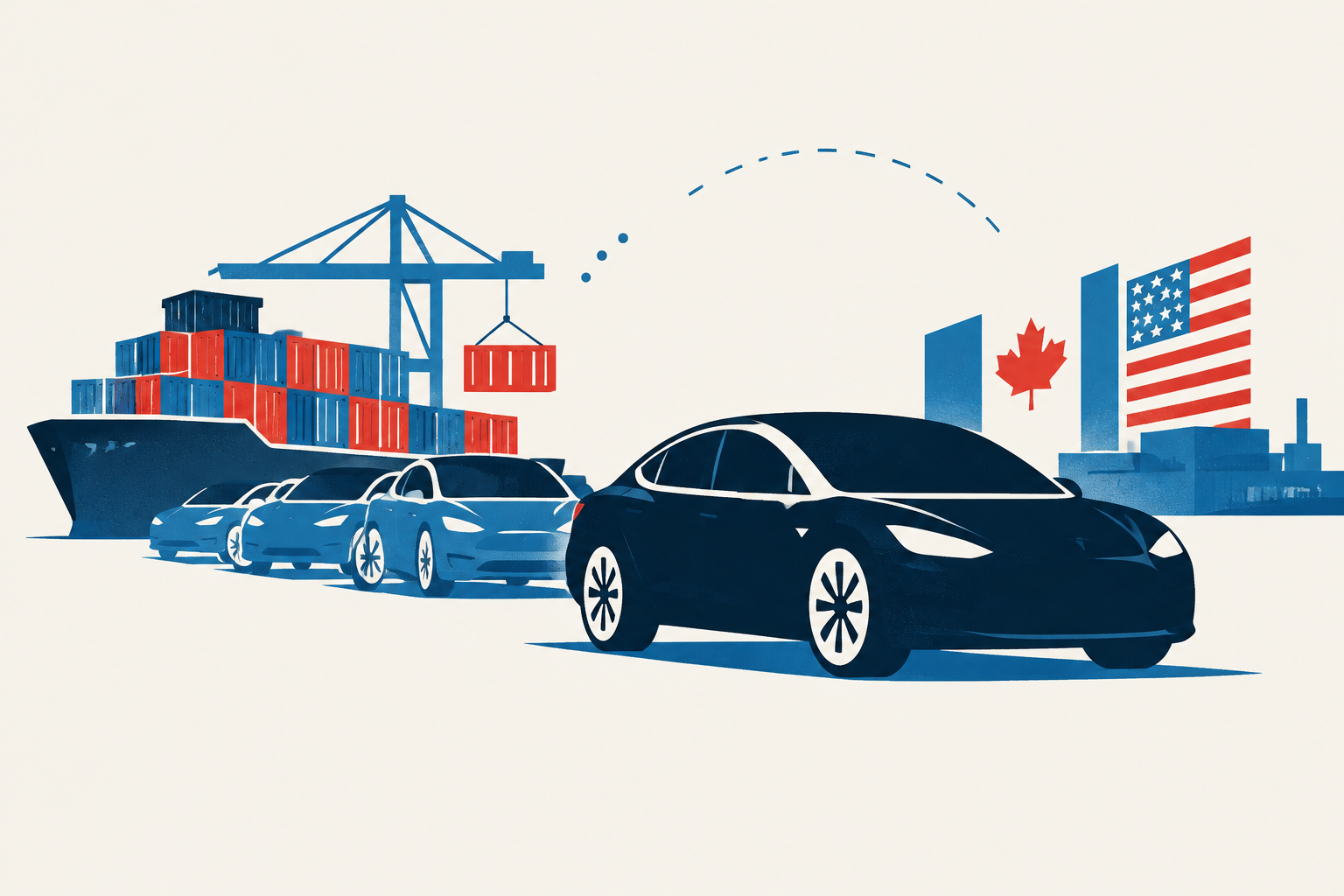
Canada’s lower-tariff quota for Chinese EV imports has so far primarily benefited Tesla, highlighting an unexpected early distribution of market access.
CTV News reports that Tesla has been the largest beneficiary so far of Canada’s policy allowing a limited volume of electric vehicles from China at reduced tariff rates. The finding is notable because the company is U.S.-based, while the policy is framed around access for China-origin EV imports rather than direct support for a Canadian manufacturer. [1]
Under a strategic partnership signed with China in January, Canada agreed to permit imports of 49,000 Chinese EVs during the current fiscal year, according to CTV. The tariff on vehicles admitted under the arrangement was reduced from 100 per cent to Canada’s most-favoured-nation rate of 6.1 per cent. [1]
The report places the arrangement in the context of Canadian contingency planning around auto employment and trade talks with the United States. Prime Minister Mark Carney has said Canada could consider turning to Chinese automakers if negotiations with the United States do not protect Canadian auto jobs, CTV reported. [1]
For the automotive sector, the early outcome underscores that preferential access for China-made EVs can benefit firms according to their production and import configurations, rather than solely by corporate nationality. The available report identifies Tesla as the leading beneficiary to date, but does not provide figures on Tesla’s import volumes, Canadian sales, effects on domestic assembly, or consequences for other automakers. [1]
That evidence supports a bounded industry-impact finding rather than a broader reassessment of Canada-U.S. auto trade conditions. The report does not establish that the quota has changed the existing tariff exposure of Canadian vehicle production, resolved bilateral auto negotiations, or produced a measured shift in vehicle prices. It instead provides an early indication of which company is capturing the immediate commercial advantage created by the reduced-duty import channel. [1]
This is a meaningful but contained automotive development: CTV reports that Tesla is the biggest beneficiary so far of Canada’s reduced-tariff quota for Chinese EV imports, exposing an early commercial effect of the policy. The significance is limited because the report provides no quantified evidence of sector-wide production, employment, price, or Canada-U.S. trade effects, and it does not demonstrate a change in the broader auto tariff environment. [1]