Canada’s Q2 trade-tax receipts fall from 2025 counter-tariff peak
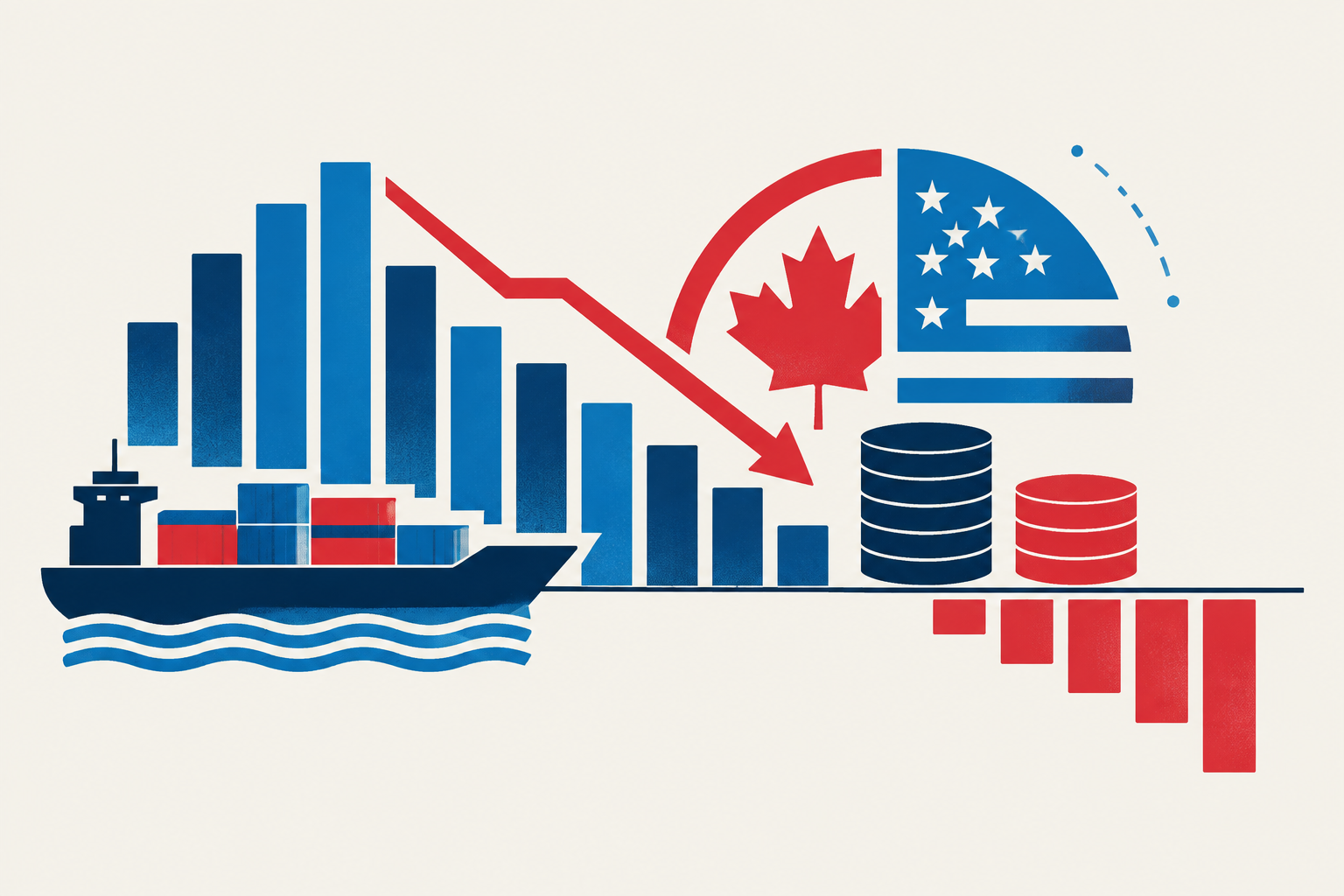
Federal trade-tax receipts fell sharply from a counter-tariff-inflated 2025 base, while second-quarter fiscal results showed a wider federal deficit.
Statistics Canada’s latest government-finance release shows federal taxes on international trade and transactions reached $2.5 billion in the second quarter of 2026, $1.1 billion, or 30.8%, below the $3.6 billion collected a year earlier. The agency said the prior-year level reflected the temporary imposition of counter-tariffs on selected U.S. imports, making the year-over-year comparison a measure of a changed tariff-revenue base rather than a standalone indicator of import demand. [1]
The quarterly figure nevertheless rose $0.6 billion, or 30.3%, from the first quarter of 2026. Trade and transaction taxes accounted for 1.9% of total federal revenue in the second quarter, versus 1.4% in the preceding quarter and 2.9% a year earlier. Statistics Canada said these receipts consist mainly of customs duties and are reported net of repayments under relief programs or remission orders. [1]
The data also place the trade-tax movement within a broader fiscal picture. Canada’s general government recorded a $10.5 billion surplus in the second quarter, up $2.3 billion from a year earlier, though the measure shifts to a $17.2 billion deficit when social security funds are excluded. The federal government posted a $4.1 billion deficit, $1.1 billion larger than in the second quarter of 2025, as expenses increased 6.3% and outpaced 5.6% revenue growth. [1]
Income, profit and capital-gains taxes increased by $6.7 billion year over year, partly offsetting the decline in trade-tax receipts. On the expenditure side, Statistics Canada attributed a $4.3 billion increase in social benefits to payments under the Canada Groceries and Essentials Benefit, while interest costs rose $0.8 billion. These results indicate that changes in customs-duty revenue were one component of, rather than the principal explanation for, the federal deficit movement. [1]
General-government net debt declined by $66.4 billion, or 12.9%, from a year earlier to $448.6 billion, as financial assets rose faster than liabilities. Excluding accumulated social-security-fund surpluses, however, general-government net debt was $1.483 trillion and 5.9% higher year over year; federal net debt increased 5.7% to $1.051 trillion. [1]
For Canada-U.S. trade tracking, the release confirms the revenue effects of changing Canadian counter-tariff coverage. Ottawa removed counter-tariffs on most U.S. imports effective September 1, 2025, while keeping tariffs on steel, aluminum and motor vehicles. Statistics Canada also noted that new targeted counter-tariffs on selected U.S. imports took effect on September 8, 2026, after the quarter covered by these fiscal data. [1]
This is a significant official fiscal-data update because it quantifies a 30.8% year-over-year fall in federal trade-tax receipts after the 2025 counter-tariff peak and records the wider federal deficit alongside lower reported general-government net debt. Its significance is moderate rather than higher because the release does not establish realized sector-level effects from the newly targeted September 2026 counter-tariffs, which began after the second quarter. [1]