Canadian carpet tariff pushes commercial buyers toward non-U.S. suppliers
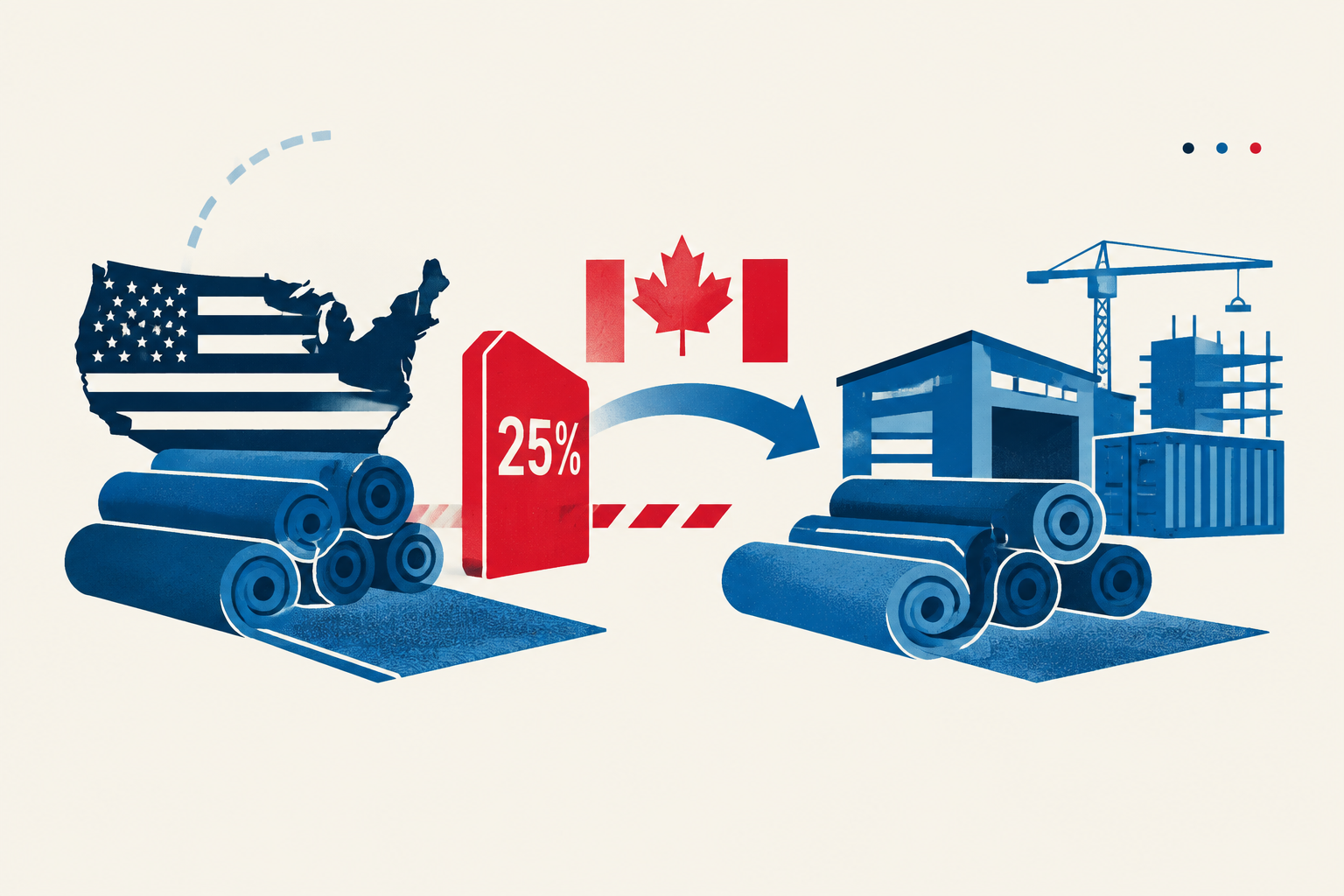
A 25% Canadian tariff on U.S. commercial carpet is reshaping sourcing decisions and adding another cost concern for construction projects.
Canada’s 25-per-cent tariff on U.S. commercial carpet is now applying without the CUSMA treatment that had previously spared many qualifying imports, according to commercial-carpet buyers interviewed by The Globe and Mail. The change is forcing purchasers to reassess established U.S. supply relationships, particularly for high-grade broadloom used in condominium, hotel and office projects. [1]
The sourcing adjustment is difficult because Canadian production does not cover the most sought-after commercial broadloom products. Armourco Solutions vice-president John Margaritis said buyers are looking beyond the United States as a result, while Toronto design company Matter & Co. is positioning French supplier Balsan as an alternative. The company’s founder said European products had already been price-competitive in some cases, and the tariff has widened the relative savings available from non-U.S. supply. [1]
The immediate effect is not uniform across contracts. Margaritis said one U.S. supplier had absorbed five percentage points of the tariff on a project, leaving his firm and the client considering how to divide the remaining cost. With hallway-carpet material for a condominium refurbishment potentially reaching $150,000, even partial pass-through can materially affect project budgets. He also described uncertainty around an order that had not entered production but was scheduled for October delivery, underscoring the commercial friction created when tariff treatment changes during procurement. [1]
The report also points to wider pressure on residential development rather than a measured decline in building activity. Ben Haythornthwaite of CoStar Group said tariffs on construction inputs could discourage new-home construction, citing the potential burden from higher costs for items such as appliances and heat pumps. His assessment reflects a concern that larger equipment-cost increases can alter development and purchasing decisions in an already weak new-home market. [1]
For buyers, diversification offers a way to reduce direct exposure to U.S. carpet tariffs, but it does not eliminate operational constraints. Matter & Co. said European imports can face customs holds, although its delivery timelines are comparable to U.S. supply at roughly eight to 10 weeks. The shift therefore involves trade-offs between tariff costs, product specifications, customs administration and the reliability of long-standing U.S. suppliers. [1]
This is a moderate industry-impact development because the tariff is changing procurement and cost-sharing decisions for a specialized construction product, while the reported broader homebuilding effect remains an expert forecast rather than a demonstrated market outcome. Exposure is concentrated among commercial-carpet buyers and projects relying on U.S.-made broadloom, with non-U.S. alternatives available but subject to customs and sourcing constraints. [1]