Canadian farm groups split over prospective Mercosur trade agreement
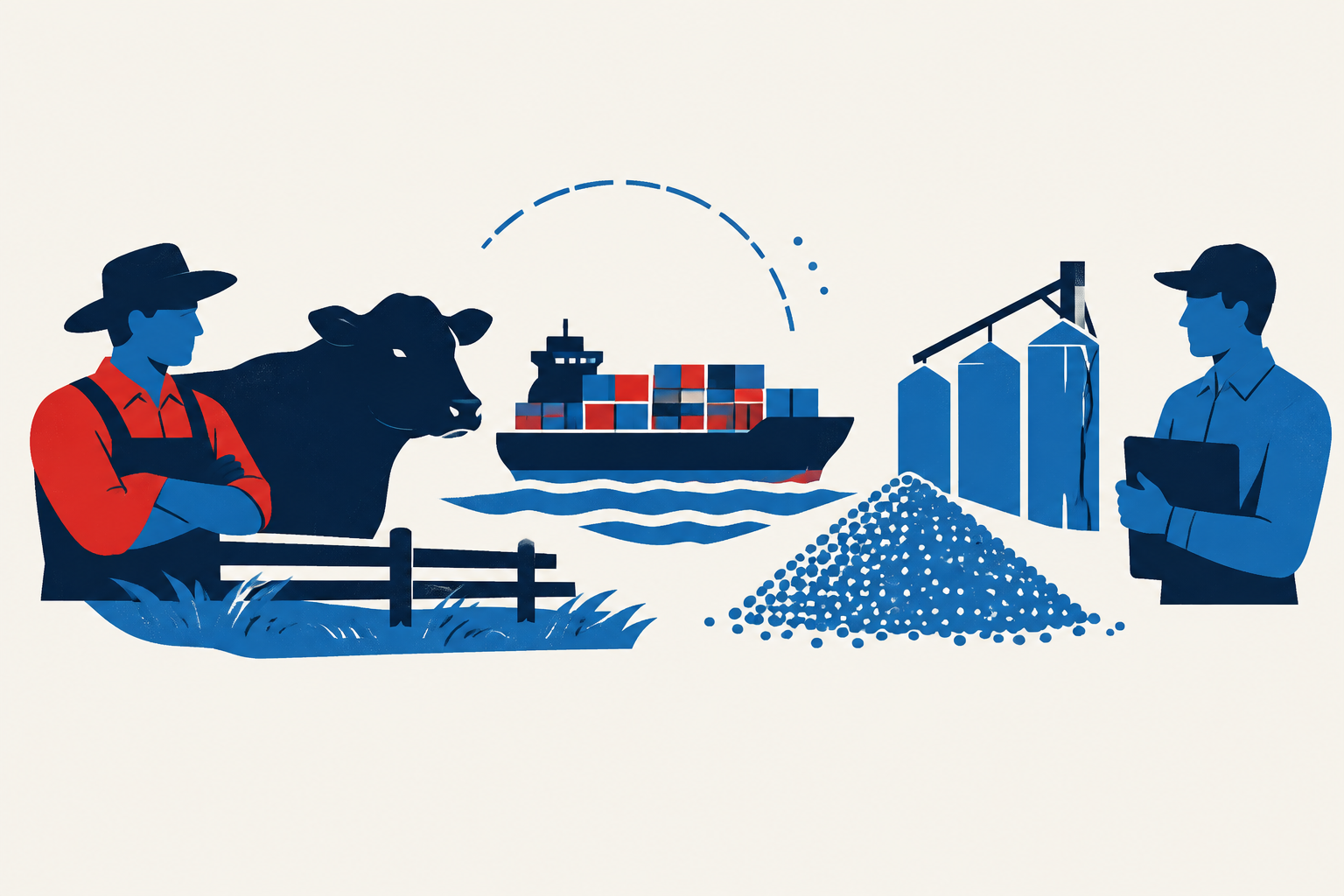
Canadian farm organizations see sharply different outcomes from a possible Mercosur deal, pitting beef-sector concerns against fertilizer-export ambitions.
Canada’s agriculture industry is presenting divergent views as Ottawa and the Mercosur bloc work toward a potential free-trade agreement by year-end. Cattle representatives have warned that further trade liberalization could weaken domestic beef production and introduce food-safety concerns, while fertilizer producers see a route to stronger export access in South America. [1]
The Canadian Cattle Youth Council raised its objections during a Parliament Hill gathering last month. Its president, Judson Christopherson, said Canada already depends on imported beef to satisfy demand and argued that an agreement should not deepen reliance on foreign food suppliers. The concern frames the prospective deal as a potential competitive and supply-chain risk for Canadian beef producers rather than simply an export-market opportunity. [1]
Fertilizer Canada has taken the opposite position. In an earlier letter to Prime Minister Mark Carney, the association’s president and chief executive, Michael Bourque, urged the government to complete and ratify an agreement, citing the prospect of expanded market access for Canadian crop nutrients, agricultural technology and expertise. Potash is already Canada’s largest export to Brazil, according to Bourque, who said Canada needs to preserve the sector’s competitiveness as Mercosur agricultural markets grow. [1]
The Canadian Federation of Agriculture has offered a more qualified assessment. President Keith Currie said a deal would need to reflect major differences in production scale, costs, regulation and market conditions, adding that gains would probably not be shared evenly across Canadian agriculture and that farmers need protections in any final arrangement. Mercosur comprises Argentina, Brazil, Paraguay and Uruguay; Canada’s merchandise trade with the bloc totalled $15.8 billion in 2024, including $3.1 billion in Canadian exports and $12.8 billion in imports. [1]
The federal government is pursuing agreements with Mercosur, the Association of Southeast Asian Nations and India before the end of the year. Canada-Mercosur negotiations began in March 2018, were paused during the pandemic and resumed in October 2025. The competing positions from producer groups underscore that any eventual agreement could create export openings for some agricultural suppliers while heightening adjustment concerns for others; no agreement has been reported as concluded. [1]
This is a modest but relevant agriculture-sector development because it documents a clear split in anticipated exposure: beef representatives identify domestic-production and food-safety risks, while the fertilizer industry anticipates potash and related export opportunities. The significance is limited because the report concerns positions on a prospective agreement, not a finalized treaty, new tariff, or realized market effect. [1]