Carney Backs Deeper Canada-E.U. Integration as Trump Warns of Tariffs on Europe
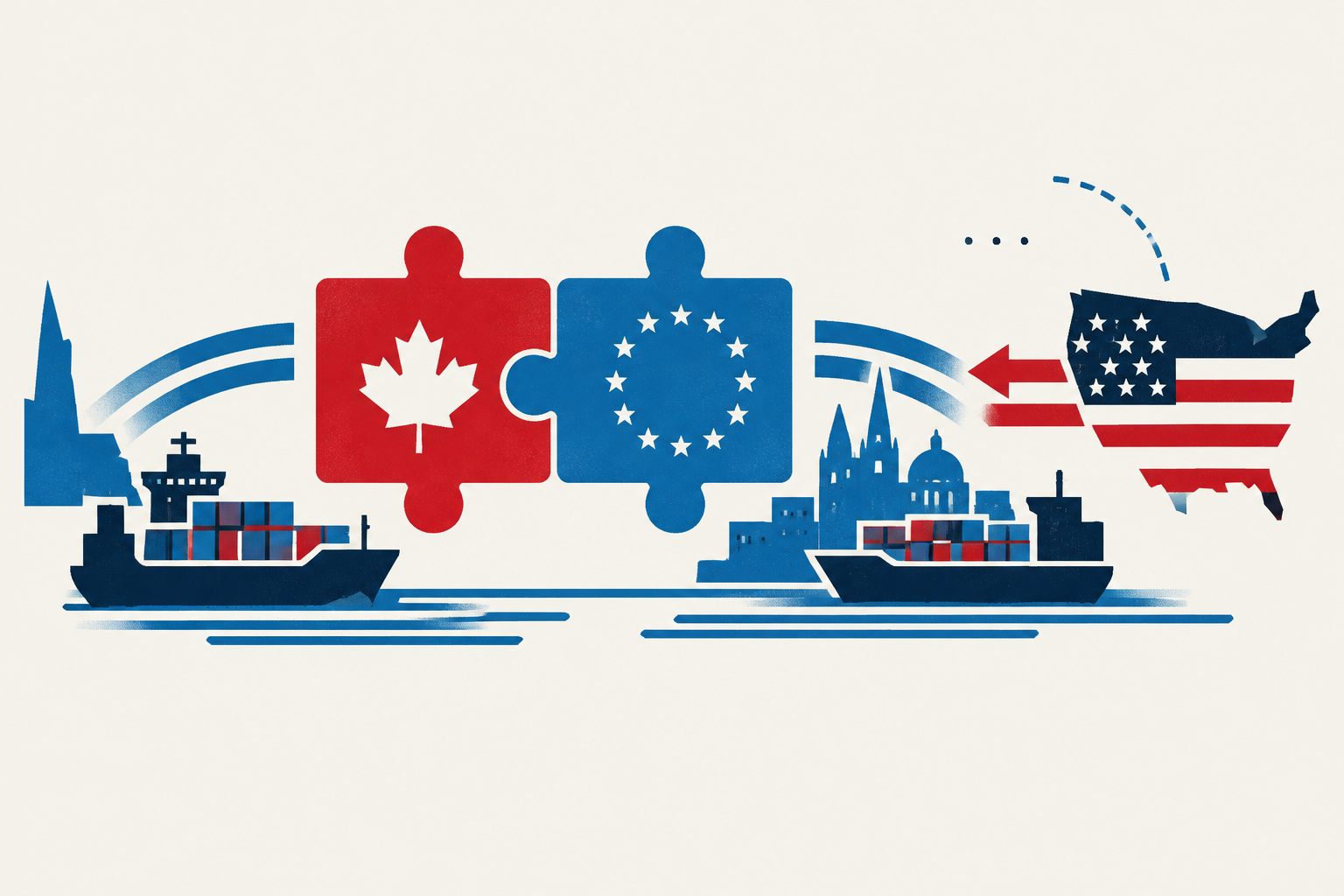
Carney’s public push for a closer Canada-E.U. partnership drew a U.S. threat of heavy tariffs on Europe, increasing uncertainty around transatlantic trade planning.
Prime Minister Mark Carney used a September 17 address to the European Parliament to endorse a closer Canada-European Union relationship, including the prospect of Canadian associate membership. He argued that Canada and Europe are stronger together amid what he described as a geopolitical rupture marked by economic coercion, tariff pressure and supply-chain vulnerabilities. [1]
Carney’s proposed areas for deeper cooperation extend beyond conventional trade. He identified critical minerals, defence industrial capacity, artificial intelligence and computing, energy security, space, and payments as strategic capabilities where closer coordination could reduce dependence on individual countries or companies. He also raised the possibility of arrangements allowing young people to work, study and live on either side of the Atlantic. [1]
The speech followed European Commission President Ursula von der Leyen’s opening of the door to a new associate-membership model for Canada. A Commission spokesperson said the initiative would be developed with member states and the European Parliament as a partnership intended to create the closest possible association with a non-European partner. Potential elements include deeper economic links, a technology alliance, defence-industrial integration, Arctic cooperation, and work on energy, critical minerals, batteries, AI, quantum technology, cybersecurity and economic security. [1]
President Donald Trump, however, characterized the proposal as laughable and said the United States could impose serious tariffs or halt trade with Europe in many areas if he considered the initiative hostile. The European Commission responded that strengthening ties with Canada was not directed against another country, but intended to reinforce shared strength. The U.S. warning places an immediate political risk around a proposed partnership that is still at an exploratory stage rather than a concluded trade arrangement. [1]
For Canadian businesses, the development reinforces the strategic importance of Europe as an alternative commercial and investment partner while also underscoring the uncertainty surrounding any move perceived by Washington as shifting economic alignment. The E.U. was Canada’s second-largest global trading partner for goods and services in 2025, with bilateral trade valued at approximately C$178.6 billion. The late-October Canada-E.U. summit in Montreal is expected to be the first substantive opportunity to discuss the proposal further. [1]
Significance is moderate because Carney publicly advanced a potentially broad Canada-E.U. economic and strategic partnership, while Trump explicitly linked possible U.S. tariffs or reduced trade with Europe to his view of the proposal. Canadian firms with European supply-chain, energy, technology, critical-mineral or defence links may gain longer-term diversification options, but no agreement, tariff action, or sector-specific commercial rule has yet been enacted. [1]