Carney Flags Chinese Auto Investment as Topic for Xi and U.S. Talks
Ottawa is keeping potential Chinese automotive investment under discussion, extending uncertainty for Ontario production and cross-border policy negotiations.
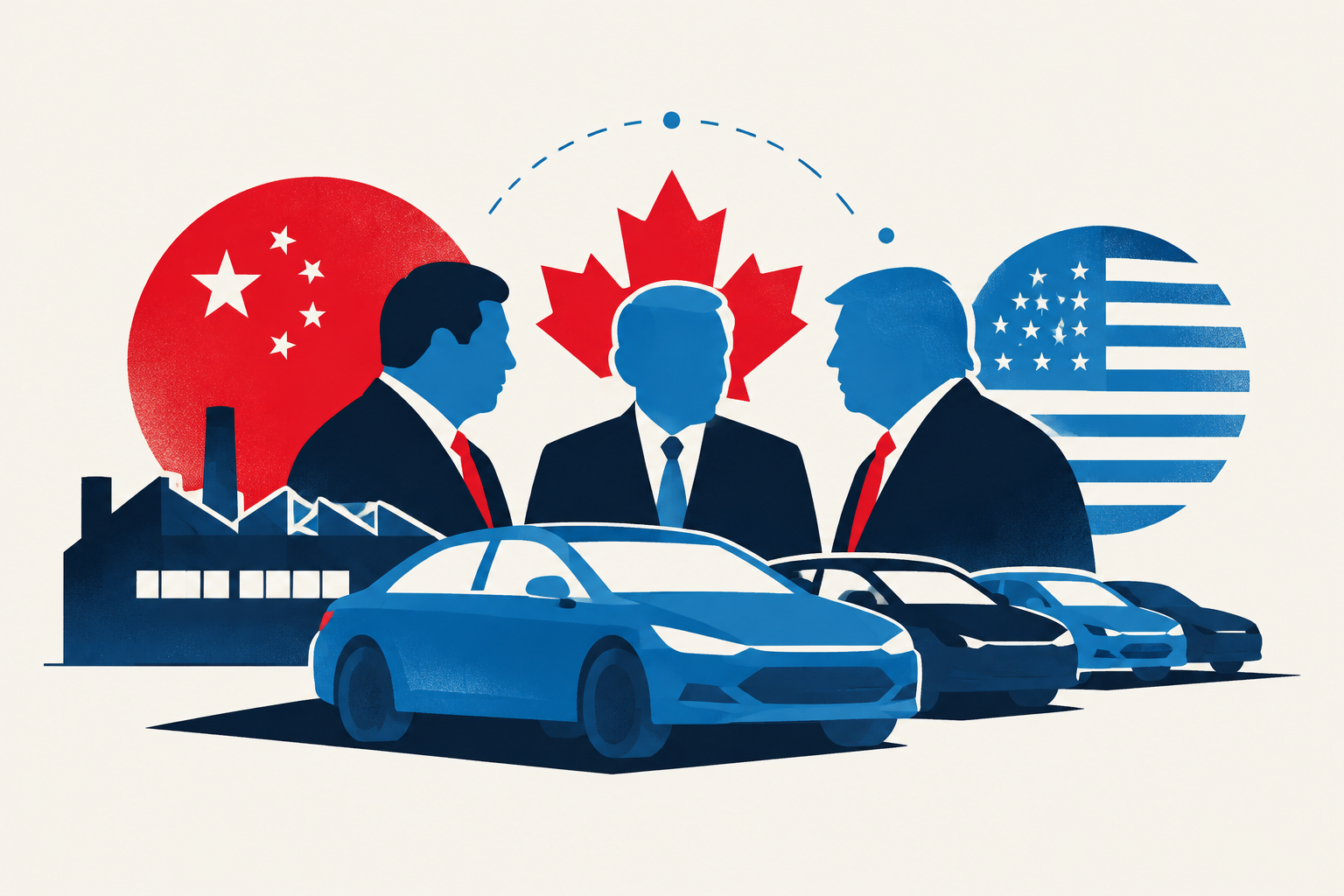
Prime Minister Mark Carney said on Nov. 12 that the scale of any Chinese investment in Canada would be discussed with Chinese President Xi Jinping and also forms part of Canada’s ongoing conversations with the United States. The remarks place prospective Chinese participation in Canada’s vehicle industry within both diplomatic and North American trade-policy channels, without announcing an investment approval, project or timetable. [1]
The comments came as Ontario Premier Doug Ford urged the federal government to oppose Chinese companies assembling so-called “kit cars” in the province. The concern is that vehicles largely manufactured in China could be shipped in pieces and assembled in Canada, an approach Ford said would hurt Ontario autoworkers. Carney did not directly answer the letter in his comments to reporters, while his office had told CTV News the previous day that Ottawa does not support kit-car production. [1]
The issue is unfolding against continuing uncertainty at Stellantis’s idle Brampton assembly plant. Carney said a planned sale of the facility to Canadian armoured-vehicle manufacturer Roshel was only a partial solution for workers, and maintained that Stellantis had not met all of its commitments to them. The plant has been idle since 2023 and more than 2,200 workers remain on layoff pay, according to the report. [1]
Ottawa has also said it will continue to challenge the Stellantis sale, arguing the company has not fulfilled agreements with federal and provincial governments. Federal support for retooling Stellantis’s Brampton and Windsor facilities had been approved at up to $529 million in 2022; records cited in the report show $222 million paid by March 2025, without a plant-by-plant allocation. Stellantis has offered to return support linked to Brampton’s original retooling plan, though the company did not disclose the amount. [1]
For auto manufacturers, suppliers and labour representatives, Carney’s statement is a policy signal rather than a change in market access or investment rules. Whether Chinese capital or assembly proposals move forward will depend on factors not specified in the remarks, including the discussions with Beijing and Washington. The immediate consequence is that prospective Chinese participation in Canadian vehicle production remains politically contested while Ottawa presses Stellantis over Brampton. [1]
Significance is limited because Carney identified Chinese auto investment as a subject for discussions with President Xi and the United States, but announced neither an investment decision nor a new trade or production rule. Automotive workers and firms in Ontario are exposed to the policy uncertainty, particularly amid the dispute over potential kit-car assembly and the unresolved Brampton situation; however, the absence of an implemented measure keeps the immediate business impact modest. [1]