Carney signals alternative auto investment path if U.S. talks fail
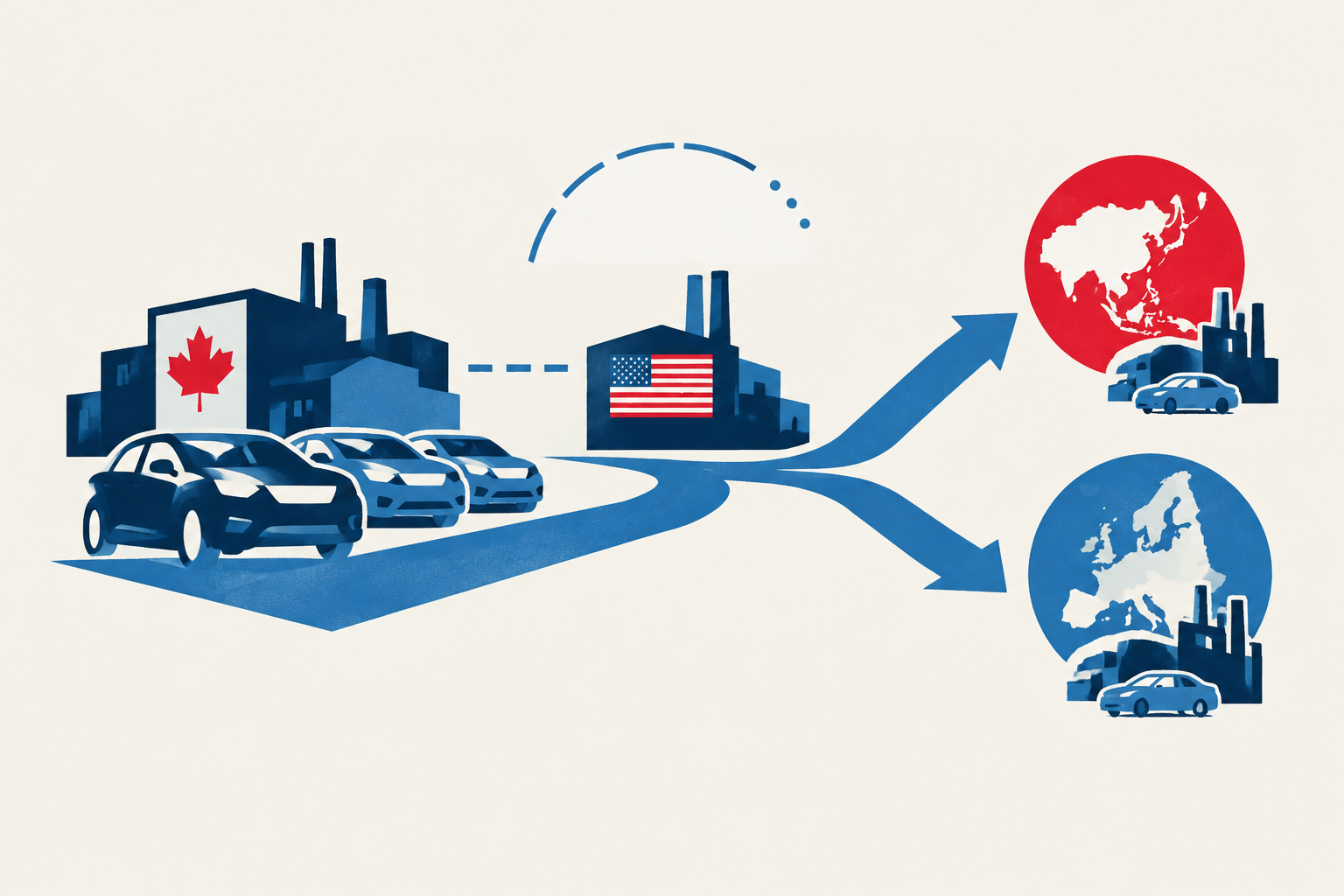
Canada is weighing conditional investment from Asian and European automakers if U.S. negotiations cannot sustain integrated North American production.
Prime Minister Mark Carney said Canada could seek automotive alternatives involving Chinese, European or Japanese companies if negotiations with the United States do not preserve an integrated North American auto industry. Speaking in Cambodia ahead of a planned meeting with Chinese President Xi Jinping in Shenzhen, Carney said talks with Washington remain Canada’s priority, but that diminished cross-border integration could create other options for Canadian auto workers and manufacturing assets. [1]
The comments add a more explicit potential investment pathway to Canada’s trade negotiating posture. Carney said he did not view possible Chinese investment as leverage against Washington, characterizing it instead as a response to changing market conditions. He said Canada would move ahead regardless of the outcome of the U.S. talks, while maintaining that any agreement with Washington must leave the country with a viable auto sector. [1]
Carney set conditions for any prospective Chinese manufacturing presence. He said investment would need to include substantial production in Canada rather than the assembly of imported parts, along with appropriate labour standards, manufacturing facilities and domestic supply chains that expand over time. He also pointed to the potential use of Canadian critical minerals in electric-vehicle supply chains. [1]
The signal comes after Canada and China reached a January arrangement that reduced Canada’s tariff on Chinese electric vehicles from 100 per cent to 6.1 per cent under a quota initially permitting up to 49,000 vehicles annually. In return, China agreed to lower tariffs on Canadian agricultural products including canola. Carney said he expected that arrangement to draw Chinese auto investment and create jobs, though Ontario Premier Doug Ford has warned that Chinese EV access could put Canadian employment and U.S. market access at risk. [1]
Canada’s established auto base remains closely linked to production in the United States and Mexico: Ford, General Motors and Stellantis operate plants across all three countries, and parts can cross borders multiple times before final vehicle assembly. CBC reported that U.S. tariffs have disrupted this model and that President Donald Trump has repeatedly pressed automakers to shift production from Canada to the United States. Carney said Canada and the United States were making progress toward a possible deal, while acknowledging unresolved differences. [1]
This is a meaningful negotiation signal for automotive businesses because the prime minister outlined a conditional alternative source of investment and tied it to Canadian production, labour and supply-chain requirements. It does not establish a new investment commitment, alter a tariff, or resolve Canada-U.S. negotiations, so it supports no change to the sector’s already severe disruption and escalation outlook. [1]