EU proposes talks on associate-member status for Canada as trade diversification push gathers pace
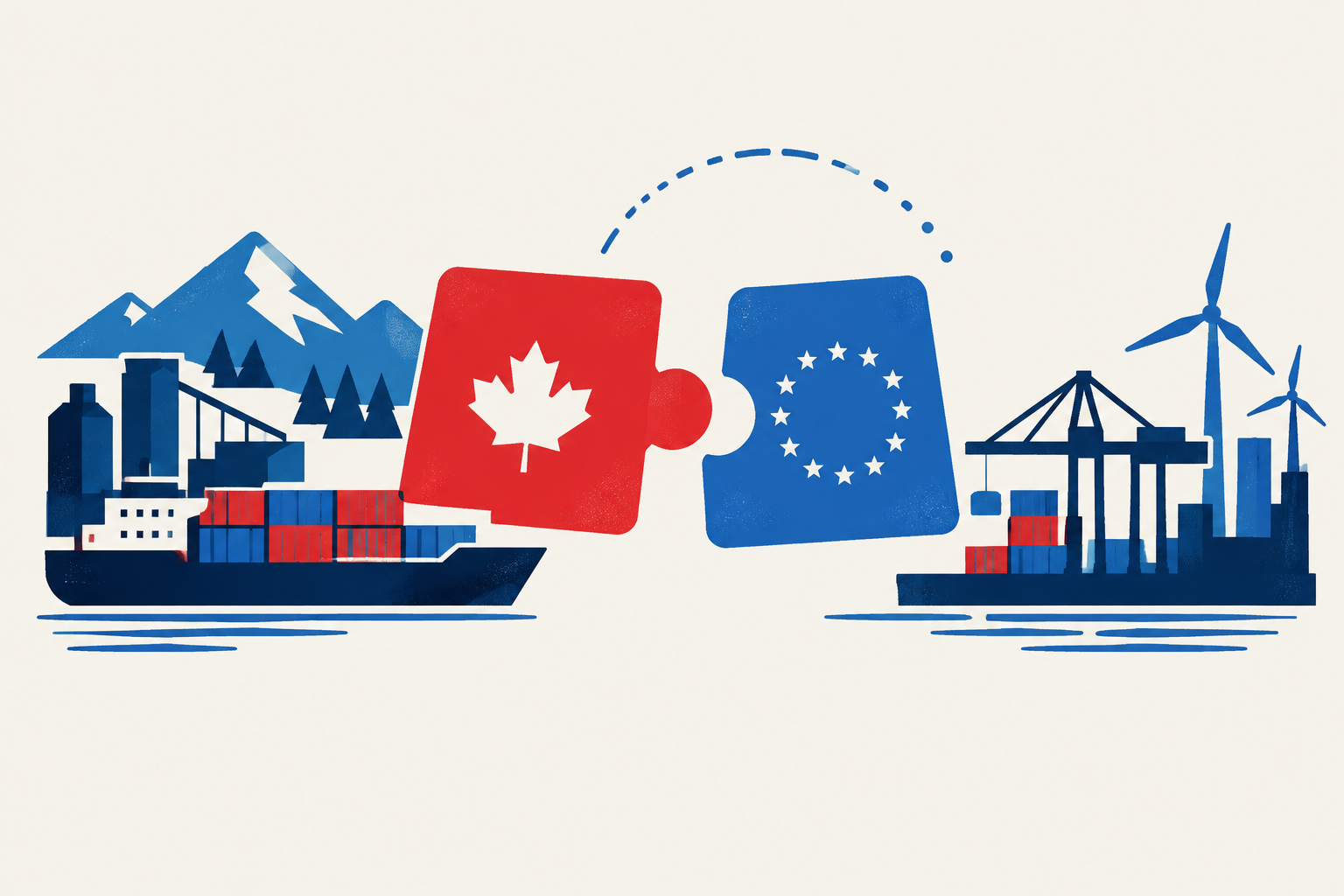
Brussels has invited Canada to explore an unprecedented associate relationship, creating a potential long-term channel for cooperation beyond existing trade arrangements.
European Commission President Ursula von der Leyen said on September 16 that she wanted to begin work with Prime Minister Mark Carney on a path for Canada to become the European Union’s first “associate member.” Carney backed closer EU ties, framing a stronger partnership as beneficial to economic, security and sovereignty interests. The proposal is an official signal to deepen the relationship, but it is not an agreement and Canada is not pursuing full EU membership. [1]
The contemplated arrangement would seek to take Canada-EU cooperation beyond the Canada-European Union Comprehensive Economic and Trade Agreement, or CETA, into a broader “Alliance for the Future.” Areas identified by the EU include manufacturing, energy, critical minerals, batteries, artificial intelligence, quantum technology, cybersecurity, Arctic policy and defence-industry cooperation. Those priorities suggest that the initiative is aimed at supply-chain resilience and strategic economic coordination as well as trade access. [1]
Important details remain unresolved. Von der Leyen did not define the rights or obligations that associate status would confer, while an EU spokesperson said Brussels would need to work with member states and the European Parliament on a new form of partnership for a country outside Europe. The late-October EU-Canada summit is described as the first meaningful opportunity for further discussion, leaving the proposal at an exploratory stage rather than creating an immediate change in commercial rules. [1]
For Canadian businesses, the announcement adds a possible longer-term diversification route while Canada remains highly dependent on the U.S. market. Business Insider reported that more than three-quarters of Canadian exports go to the United States and that automotive and energy supply chains are tightly integrated across the border. Closer links with Europe could eventually offer additional avenues for Canadian energy and critical-mineral exports, but any shift in trade patterns would take time and depend on the eventual design of the proposed association. [1]
The initiative follows a period of worsening Canada-U.S. trade friction and collapsed bilateral trade talks, according to the report. It therefore has strategic value as a public commitment by the EU to consider a deeper partnership with Canada. However, neither side has set out market-access commitments, implementation dates or sector-specific obligations, so companies should treat it as a negotiation signal rather than a near-term substitute for U.S.-oriented trade relationships. [1]
Associate membership is not an established category in the EU's institutional structure and has no binding definition in EU law, ABC News reported. Any rights, obligations or market-access terms remain to be negotiated, reinforcing that the proposal creates no immediate change in trade rules. [2]
Significance is moderate because the European Commission has publicly proposed an unprecedented associate-member discussion and Canada has endorsed closer ties, giving diversification efforts a concrete diplomatic opening. Exposure is broadest for strategic sectors named by the EU, including manufacturing, energy and critical minerals, but the rating is not higher because the status has not been defined, negotiated or implemented; substantive discussion is only expected to begin at the late-October summit. [1]