Canada, Philippines conclude free-trade negotiations, target 2027 signature
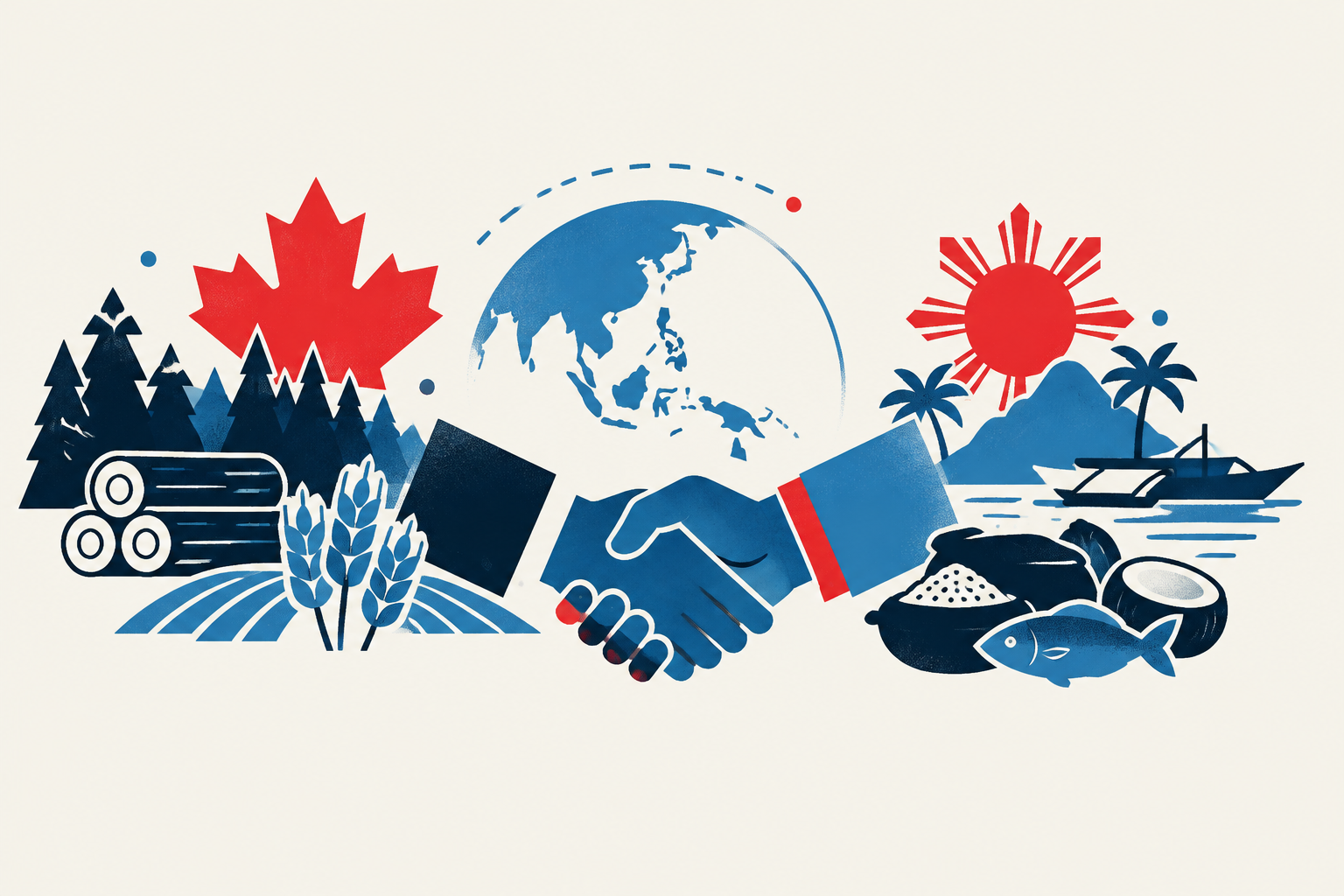
Concluded Canada-Philippines trade talks set up a 2027 signature, offering prospective new market access for agricultural and forest-product exporters.
Canada and the Philippines have concluded negotiations for a bilateral free-trade agreement, moving the initiative from active talks to a completed negotiating outcome. Prime Minister Mark Carney and Philippine President Ferdinand Marcos Jr. announced the result during a bilateral visit in Manila on November 14, 2026. The two governments are now working toward signing the agreement in 2027, meaning its commercial provisions are not yet in force. [1]
The Canadian government presents the agreement as part of its broader effort to diversify trade relationships in Southeast Asia and reduce reliance on a single market. It says the Philippines has an economy valued at $680 billion, a population exceeding 110 million, and is among Asia’s faster-growing economies. In 2025, Canada-Philippines merchandise trade totalled $3.4 billion, while Canada’s direct-investment stock in the Philippines was approximately $1.7 billion. [1]
Once implemented, the agreement could increase Canadian exports to the Philippines by as much as three times by 2035, according to the federal government. Ottawa specifically identified agriculture and forest products as sectors that could gain improved access and greater commercial certainty. That projection is contingent on signature, ratification and entry into force; the release does not provide product-level tariff schedules, rules-of-origin terms, or a timetable for implementation. [1]
The Philippines announcement was made alongside Canada’s substantial conclusion of negotiations toward an ASEAN-Canada free-trade agreement. The government said the ASEAN agreement, also targeted for signature in 2027, would expand Canada’s integration into Asian supply chains and create more predictable trading conditions. The bilateral Philippines agreement is separate from that regional process, although both initiatives support Canada’s push for additional customers and investment links in Southeast Asia. [1]
Canada also announced commercial memorandums involving ocean technology, drone technology and renewable-energy investment in the Philippines, as well as cooperation on customs, security, agriculture and infrastructure. These arrangements do not establish the free-trade agreement’s market-access terms, but they indicate parallel efforts to deepen the commercial relationship while the treaty moves toward signature and subsequent domestic approval processes. [1]
The conclusion of negotiations is a meaningful status change because it creates a defined path toward a Canada-Philippines free-trade agreement and potential new export opportunities, particularly for agriculture and forest products. Its significance is tempered because the agreement has not been signed or entered into force, and the projected tripling of exports by 2035 is a government forecast rather than a realized outcome. [1]