Canada-U.S. Rail Volumes Rebound After Short-Lived Ban Shock
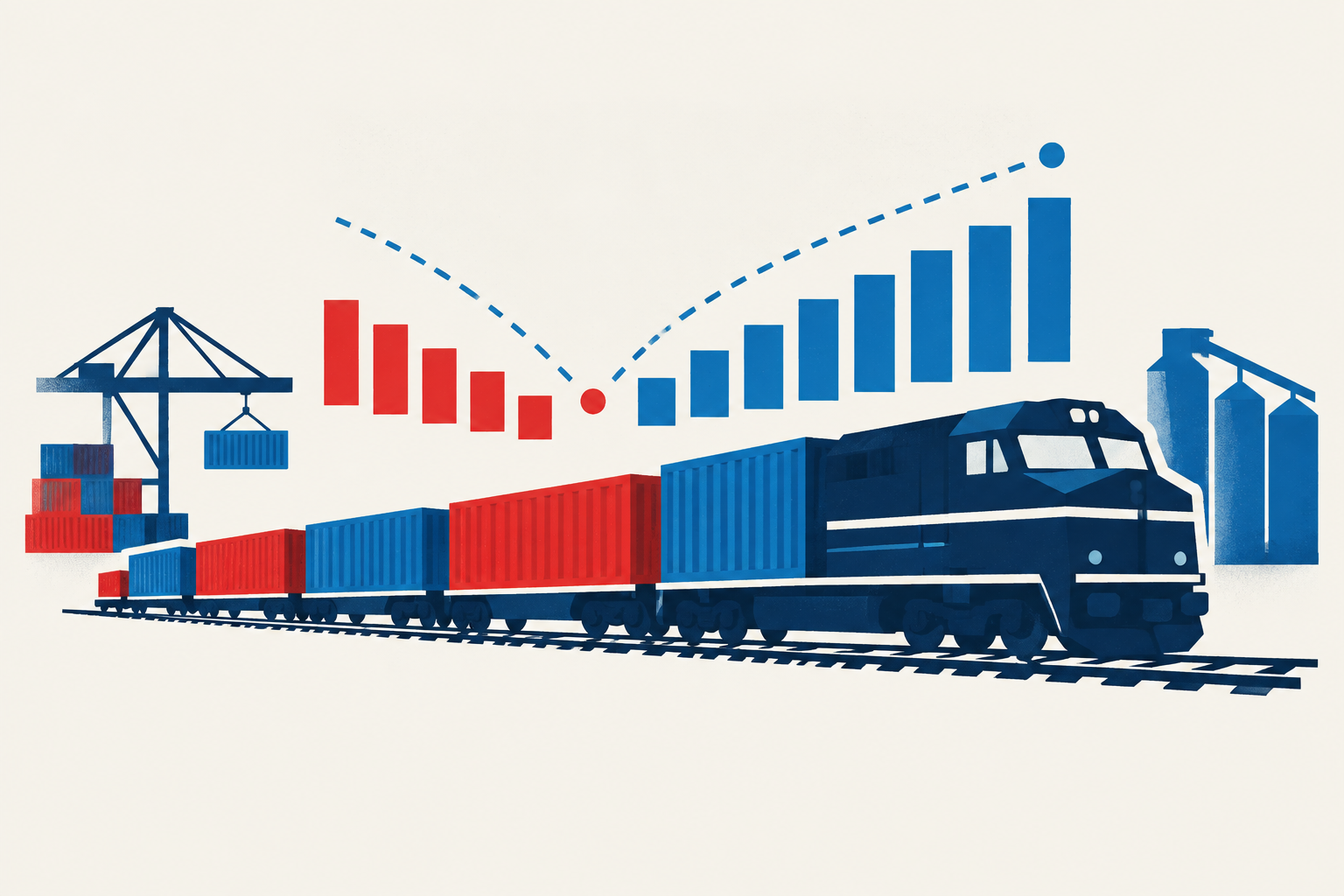
Canada-to-U.S. loaded rail-container traffic quickly recovered after a September ban-related drop, limiting the immediate disruption to broader freight flows.
FreightWaves’ SONAR data show that loaded rail-container traffic from Canada to the United States fell sharply to an index reading of 601 on September 8, the day a U.S. ban was announced on specified Canadian goods. The decline was short-lived: within roughly a week and a half, the Canada-to-U.S. index had recovered above 960 before returning to its prevailing 750-to-900 range. [1]
The pattern matters because it points to a bounded logistics effect rather than a sustained cross-border freight interruption. FreightWaves said Canada-to-U.S. rail-container volumes had already been drifting lower through late August, with a regression through the February-to-late-August period indicating an approximately 10% decline. But it characterized the September movement as a temporary wobble, noting that Labor Day-period weakness is typical in the series and that volumes quickly returned near normal. [1]
The ban followed a wider trade dispute that includes a 10% U.S. Section 301 tariff on Canada and a separate 50% Section 338 tariff on Canadian dairy, motor vehicles and alcoholic beverages, according to FreightWaves. The September measure applied to product lines within those same broad sectors, replacing the tariff treatment with an import prohibition for the specified goods. Canada’s retaliatory list, meanwhile, spans more than 800 tariff lines, including steel and aluminum, furniture, apparel, dairy, appliances, agricultural equipment, pulp and paper, and electronics. [1]
Exposure is uneven across the products discussed. FreightWaves’ comparison of 2025 Canadian imports with U.S. market size found that beer, molasses, non-alcoholic beer and wine each represented less than 1% of their respective U.S. markets. Motorcycles, spirits and whey/dairy were larger but still modest shares, ranging from 1.3% to 1.9%. The article identified spirits as the most commercially consequential of the listed categories because of its comparatively large U.S. trade deficit with Canada. [1]
For transport operators and shippers, the immediate evidence argues against treating the September rail decline as proof of a lasting system-wide demand shock. Targeted exporters and importers in affected automotive and dairy-related product lines remain exposed to direct trade restrictions, while the broader rail network appears to have absorbed the initial disruption. The longer-running erosion in the rail index nonetheless leaves freight demand sensitive to further changes in the broader tariff dispute. [1]
The reported development is significant as a timely read on realized logistics effects following the September ban: Canada-to-U.S. loaded rail-container traffic dropped sharply but rebounded above its pre-drop level within about a week and a half. Automotive- and dairy-related supply chains are directly exposed to the targeted measures, but the rating remains limited because FreightWaves found little enduring effect on the wider freight network or economy. [1]