Canadian aluminum tariffs raise Nine Pin Ciderworks’ canning costs by 30%
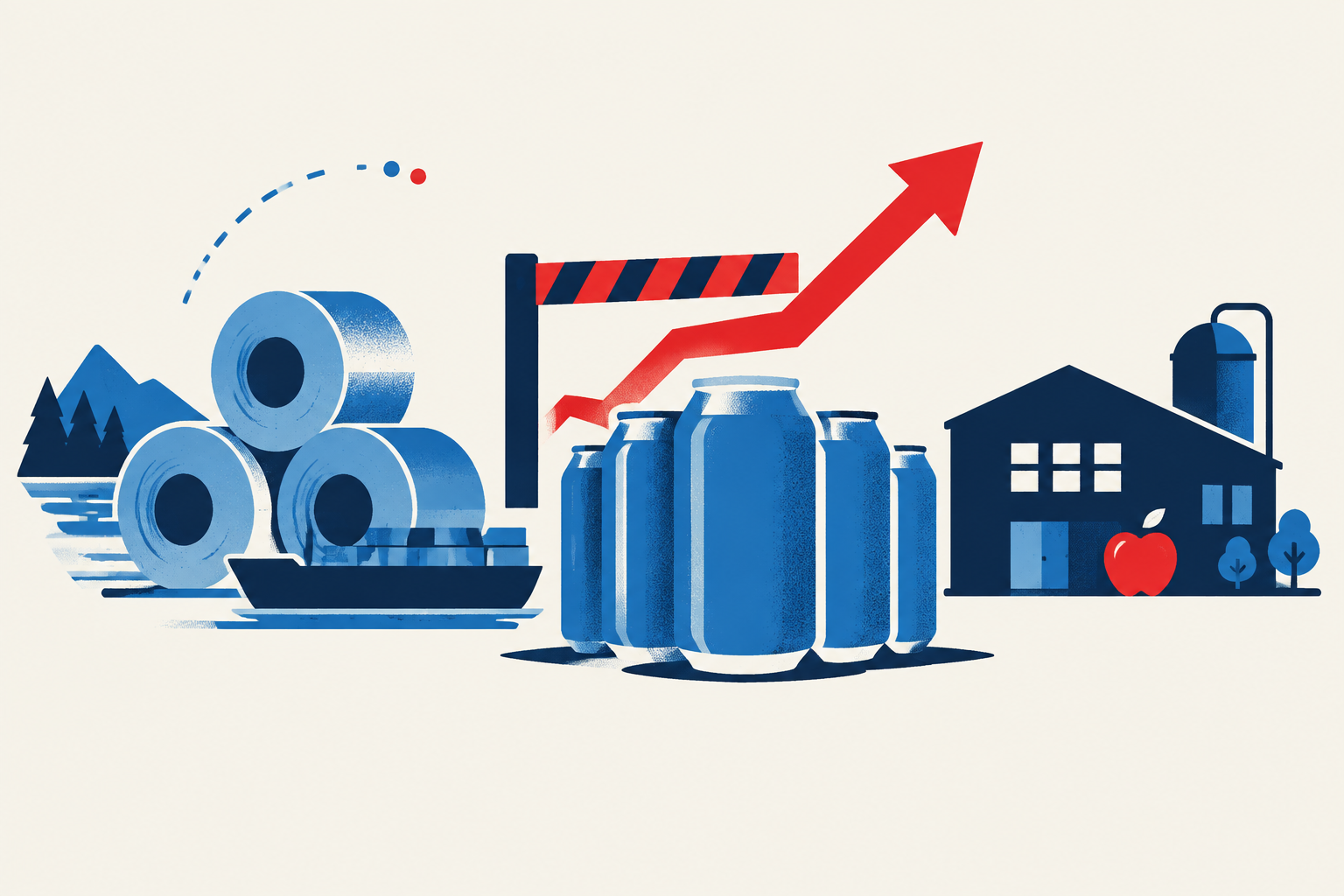
An upstate New York cidery says tariffs on Canadian aluminum have lifted packaging costs, tightening margins and delaying expansion choices.
Nine Pin Ciderworks, a farm cidery in North Albany, New York, says the tariffs affecting Canadian aluminum have increased its canning costs by 30%. The company uses roughly 2.4 million cans a year, and although the cans are made by Ball Co. in nearby Saratoga, the aluminum sheet used to make them is imported from Canada. [1]
The reported cost increase is pressuring the cidery’s margins and has prompted it to expand its bank credit line, according to co-founder Sonya del Peral. Nine Pin says the added packaging expense has also made it harder to assess expansion and other major investments, illustrating how exposure can persist even for a business that sources most of its apples from a nearby orchard. [1]
The report places the company’s experience in the context of substantial Canada-New York trade flows. More than US$21.1 billion in goods enters New York from Canada annually, including US$1.1 billion in aluminum goods, according to Canadian government figures cited by WXXI. The United States imposed a 50% tariff on steel and aluminum imports beginning last year, with the administration presenting the action as an effort to support domestic metals production. [1]
Nine Pin has not yet passed the higher costs through to customers. Its flagship cider remains priced at US$12 for a four-pack, but the company says it is cautious about raising prices because consumers are making careful spending decisions. Del Peral said maintaining current pricing may not be sustainable indefinitely, leaving the business to absorb costs while trying to protect demand. [1]
For Canadian aluminum suppliers and U.S. manufacturers dependent on Canadian metal inputs, the account is a specific example of downstream packaging exposure rather than evidence of a broad change in sector-wide conditions. The source also reports that U.S.-Canada trade talks had collapsed in August and that a U.S. senator introduced legislation to repeal the Canadian tariffs, but neither development changes the tariff treatment described by Nine Pin. [1]
This is a moderate-significance business-impact report: a named U.S. cidery attributes a 30% increase in canning costs to tariffs on Canadian aluminum, with margin pressure, greater reliance on bank credit and delayed expansion decisions. The impact is concrete but limited to one company’s packaging supply chain, while the report does not establish a new tariff measure or a sector-wide change in Canadian steel and aluminum trade conditions. [1]