Canadian primary steel employment roughly halves as Stelco layoffs underscore broader pressure
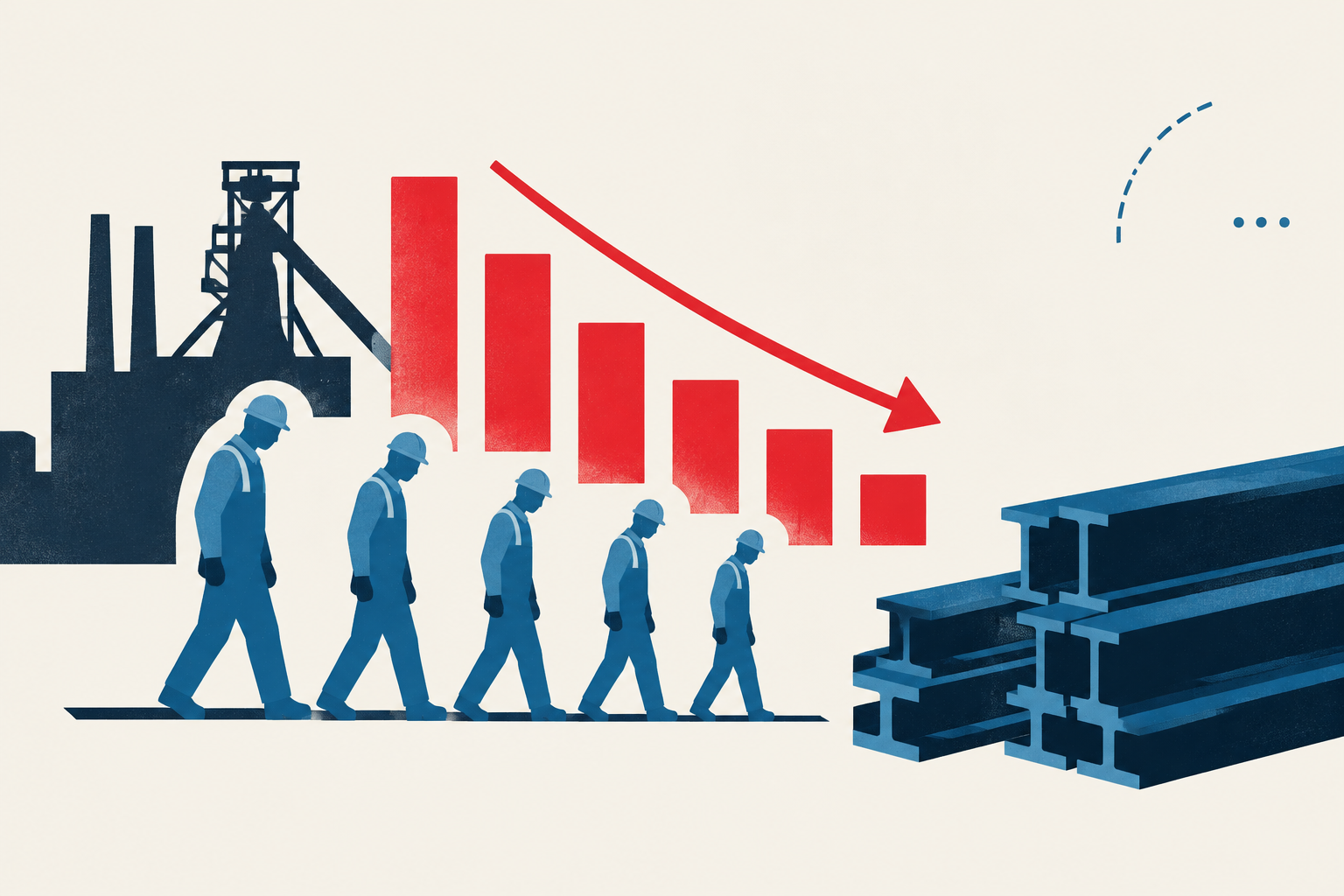
New data show Canada’s primary steel workforce has roughly halved since 2003, highlighting structural pressure alongside current tariff-linked layoffs.
Statistics Canada data cited by CBC show direct employment in Canada’s primary steel manufacturing industry fell from nearly 29,000 workers in 2003 to about 14,000 in July 2026. The latest Stelco layoffs are therefore occurring within a much longer contraction in the sector’s direct workforce, rather than representing an isolated disruption at one company. [1]
Stelco Holdings laid off 85 employees in the previous week and had issued 90 layoff notices the week before, according to United Steelworkers Local 1005 president Ron Wells. The U.S.-owned producer has said it could lay off up to 500 workers at its Hamilton and Nanticoke, Ontario, operations, characterizing the planned reductions as temporary consequences of the Canada-U.S. trade conflict. [1]
CBC reports that automation and changing demand have also reduced labour needs in steelmaking. Cleveland-Cliffs, Stelco’s owner, cut its total workforce from about 30,000 at the end of 2024 to roughly 25,000 at the end of 2025, according to U.S. regulatory filings cited in the report. The company attributed a furnace idling and related U.S. reductions to softer North American automotive demand. [1]
Tariff pressure remains an important immediate risk for Canadian producers. CBC says Stelco announced its potential Ontario cuts in late September, three months after the United States applied tariffs of up to 50 per cent on certain Canadian steel and aluminum imports. A Wood Mackenzie analyst told CBC that the higher U.S. steel tariffs have disrupted established trade flows, increasing pressure on Canadian export volumes and capacity utilization even as U.S. producers gain market share. [1]
Other Canadian steel employers are also adjusting operations. Algoma Steel had issued notices affecting about 1,000 workers while advancing a transition to less labour-intensive electric-arc-furnace production, CBC reported. Separately, ArcelorMittal Long Products Canada permanently closed a Hamilton wire-drawing operation in 2025, citing economic conditions, increased steel imports and market pressures. [1]
The reported employment decline does not establish that all current losses are permanent or solely tariff-driven. Stelco’s union expects affected workers could be recalled if trade conditions improve, while the company and Ottawa remain in dispute over employment commitments attached to the firm’s Canadian investment approval. [1]
The development is significant because the Statistics Canada workforce trend indicates a broad, long-running erosion of direct employment in primary steel manufacturing, while Stelco’s potential cuts make the exposure immediate for Ontario workers and suppliers. The rating is bounded because the report attributes the contraction to a mix of technology, demand and tariff-related pressures, and Stelco describes its planned layoffs as temporary rather than a confirmed permanent capacity closure. [1]