Canadian steelmakers find partial relief in domestic projects as U.S. market access shrinks
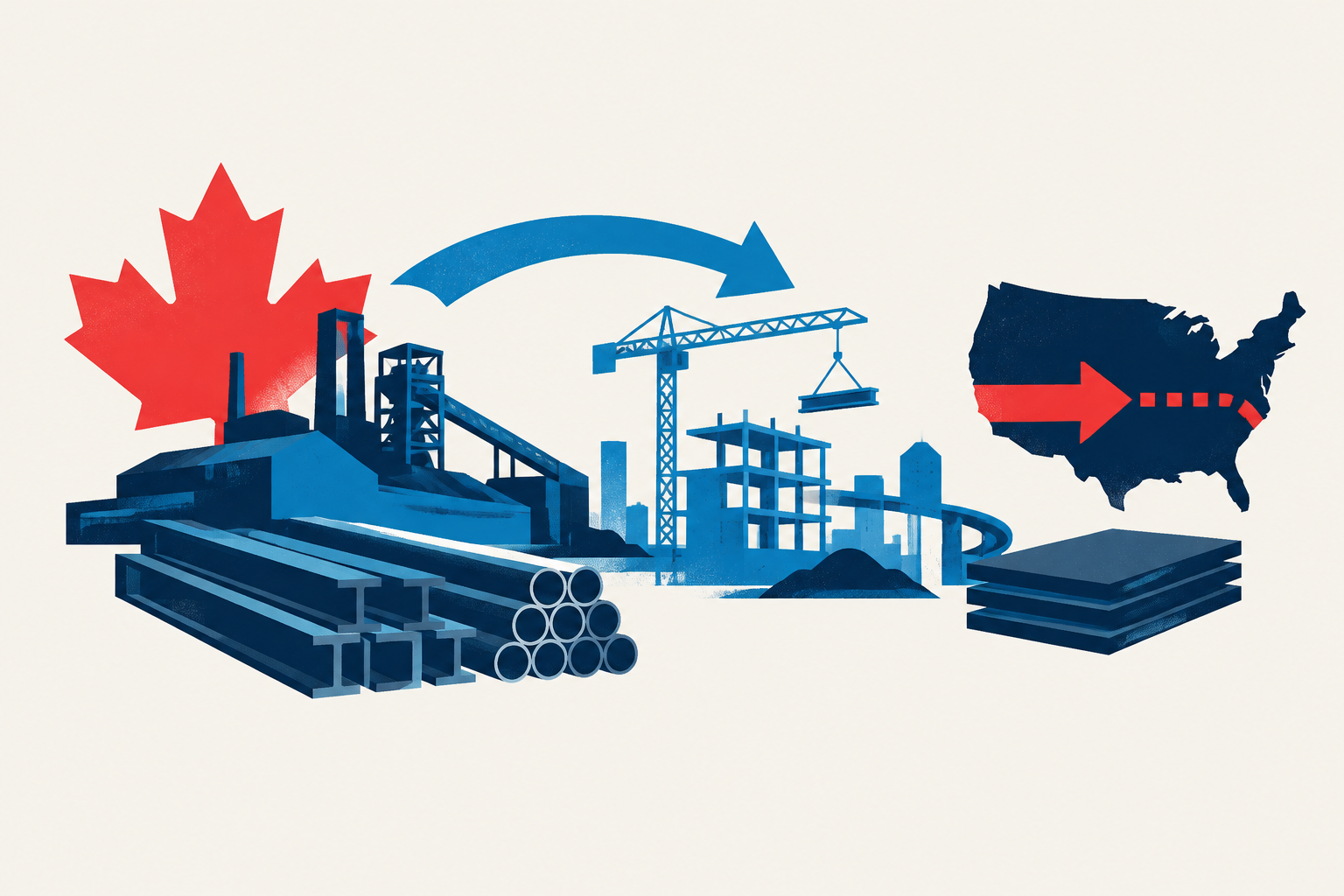
Rising Canadian project activity and import displacement are giving steelmakers a partial domestic buffer against lost U.S. sales.
Canadian steel producers are reporting an uneven but meaningful shift toward the home market after U.S. tariffs sharply curtailed their traditional export outlet. The proportion of steel consumed in Canada that was made domestically reached 51% in 2025, up from 41% in 2024, according to calculations by the United Steelworkers using World Steel Data and Canadian import data. The corresponding import share fell to 49% from 59%, indicating that domestic producers have captured a larger portion of Canadian demand. [1]
The adjustment follows the June 2025 increase in U.S. steel tariffs to 50%, which prompted companies to diversify away from the United States and concentrate more on Canadian customers, according to steelmakers, analysts and union representatives cited by BNN Bloomberg. Canada had previously sent roughly 90% of its steel exports to the U.S., but those shipments dropped 60% in 2025, the Canadian Steel Producers Association said. The loss of export volume has still resulted in hundreds of layoffs, underscoring that stronger home-market demand has not repaired all of the tariff damage. [1]
New demand is being supported particularly by industrial activity in Western Canada, including mining, energy and AI data-centre construction. BNN Bloomberg cited a 1.2-gigawatt Saskatchewan data centre under construction and referenced prospective pipeline-related demand, while an OECD report estimated Canadian steel demand grew about 2.7% in 2025 and projected growth of about 0.9% in 2026. Supreme Steel said more Canadian companies are competing for domestic business and that its fabricated-steel outlook is supported by a pipeline of projects. [1]
Government policy is also part of the sector’s adjustment. Ottawa announced $1 billion in working-capital loans for steel, aluminum and copper industries in May and extended a tariff-rate quota limiting foreign steel imports, measures intended to help domestic producers withstand tariff disruption and lower-cost foreign competition. The Finance Department said its Buy Canadian policy and broader growth agenda were intended to support a domestic demand cycle for Canadian steel, while acknowledging that the sector remains exposed to U.S. tariffs. [1]
Company results illustrate both the opportunity and the limits of the pivot. Tenaris said it invested $306 million to expand Canadian production for Canadian oil-and-gas customers, reducing its exposure to U.S. tariffs. Cleveland-Cliffs cited improved demand for certain Canadian hot-rolled steel products, while Algoma said its Canada-focused, plate-first strategy was working even as U.S. Section 232 tariffs effectively blocked its historic U.S. market access. Yet Algoma had announced 1,000 Ontario layoffs, and the union said a broader recovery would require further replacement of imported steel with Canadian output. [1]
This is a moderate industry-impact development because the domestic share of Canadian steel consumption rose by 10 percentage points in 2025 and project-led demand, import controls and public support are helping some producers offset reduced U.S. sales. The rating is not higher because exports to the U.S. fell 60%, layoffs continue and the improvement is uneven across regions and products. [1]