Deloitte cuts 2027 Canada growth forecast as trade uncertainty deepens
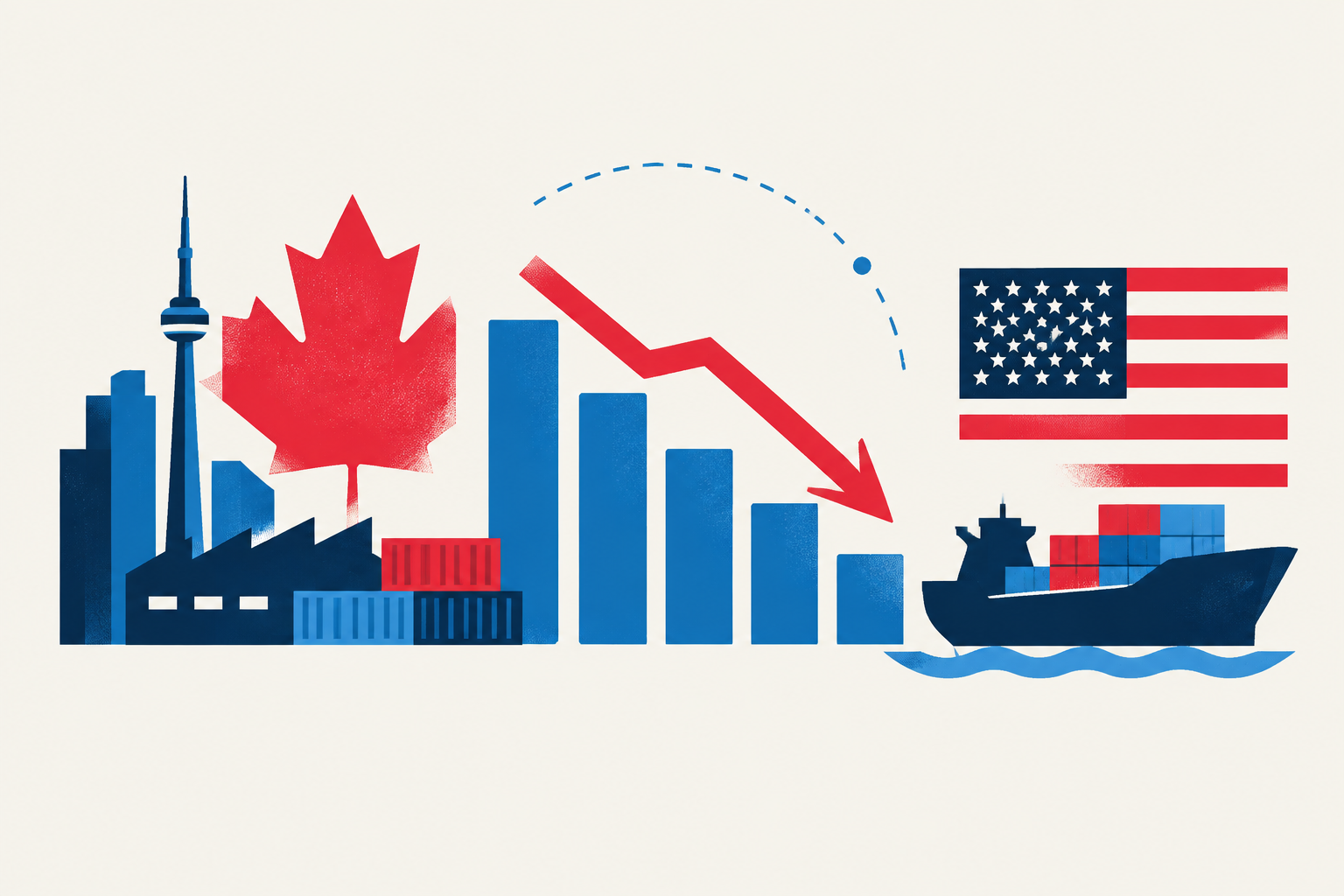
Deloitte lowered its 2027 Canadian growth outlook to 1.6 per cent, signalling a weaker near-term environment for households and businesses.
Deloitte Canada has reduced its forecast for Canadian real GDP growth in 2027 to 1.6 per cent, down from the two per cent projection it issued in late June. The firm expects recent escalation in the Canada-U.S. trade conflict to contribute to a pronounced slowdown late this year and into early 2027, while describing a more difficult operating environment for consumers and companies. [1]
The revised 2027 outlook contrasts with a modest upgrade to Deloitte’s 2026 forecast, which now calls for 0.9 per cent growth rather than 0.7 per cent. Deloitte chief economist Dawn Desjardins said the burden from U.S. tariffs and Canadian reciprocal measures will vary across the economy: some sectors will face acute pressure, while fiscal support, investment initiatives and defence spending could support activity and employment in selected areas. [1]
The forecast was released as the United States halted imports of certain Canadian alcohol, motorcycles, molasses and whey products. CBC also reported that additional Canadian goods had been added earlier in September to products facing 50 per cent U.S. tariffs. Those actions add trade friction for affected exporters, but Deloitte’s outlook frames the broader consequence as weaker confidence and slower aggregate growth rather than a uniform hit across every industry. [1]
Deloitte’s assessment points to caution among both businesses and households. Desjardins cited uncertainty over prospective cost increases, trade barriers with Canada’s largest trading partner and potentially higher interest rates. She said that uncertainty could encourage Canadians to save more and defer spending, reducing a key source of domestic demand. These are forecast risks, not confirmed economy-wide outcomes. [1]
Current activity data also show a softer starting point. Statistics Canada reported that GDP was essentially unchanged in July after three months of growth, with gains in construction and utilities offset by declines elsewhere in goods-producing industries; services activity was also broadly flat. Its preliminary estimate indicated 0.2 per cent growth for August, led in part by mining and retail trade while oil and gas extraction declined. [1]
For trade-exposed businesses, the immediate implication is not a new tariff estimate but a weaker macroeconomic baseline for planning. Deloitte’s revised forecast reflects the combined effect of trade measures, reciprocal actions and confidence-sensitive spending decisions. At the same time, the firm’s 2026 upgrade and its expectation that some targeted sectors may benefit from public and private investment argue against interpreting the revision as a forecast of a broad-based contraction. [1]
Deloitte's outlook also projects exports to fall at annualized rates of 0.9 per cent in the third quarter and 5.0 per cent in the fourth quarter of 2026. It identifies Ontario manufacturing and Quebec aluminum as particular regional exposures. These are forecasts, not realized losses. [2]
This is a meaningful macroeconomic downgrade because Deloitte lowered its 2027 growth forecast by 0.4 percentage points, from 2.0 per cent to 1.6 per cent, citing difficult conditions tied in part to U.S. tariffs and Canadian reciprocal measures. The exposure is economy-wide through business costs and consumer confidence, but the significance is moderated because Deloitte still forecasts growth in both 2026 and 2027 and expects impacts to differ substantially by sector. [1]