Internal Canadian assessment flags $2.8B in EU carbon-charge exposure for metals exporters
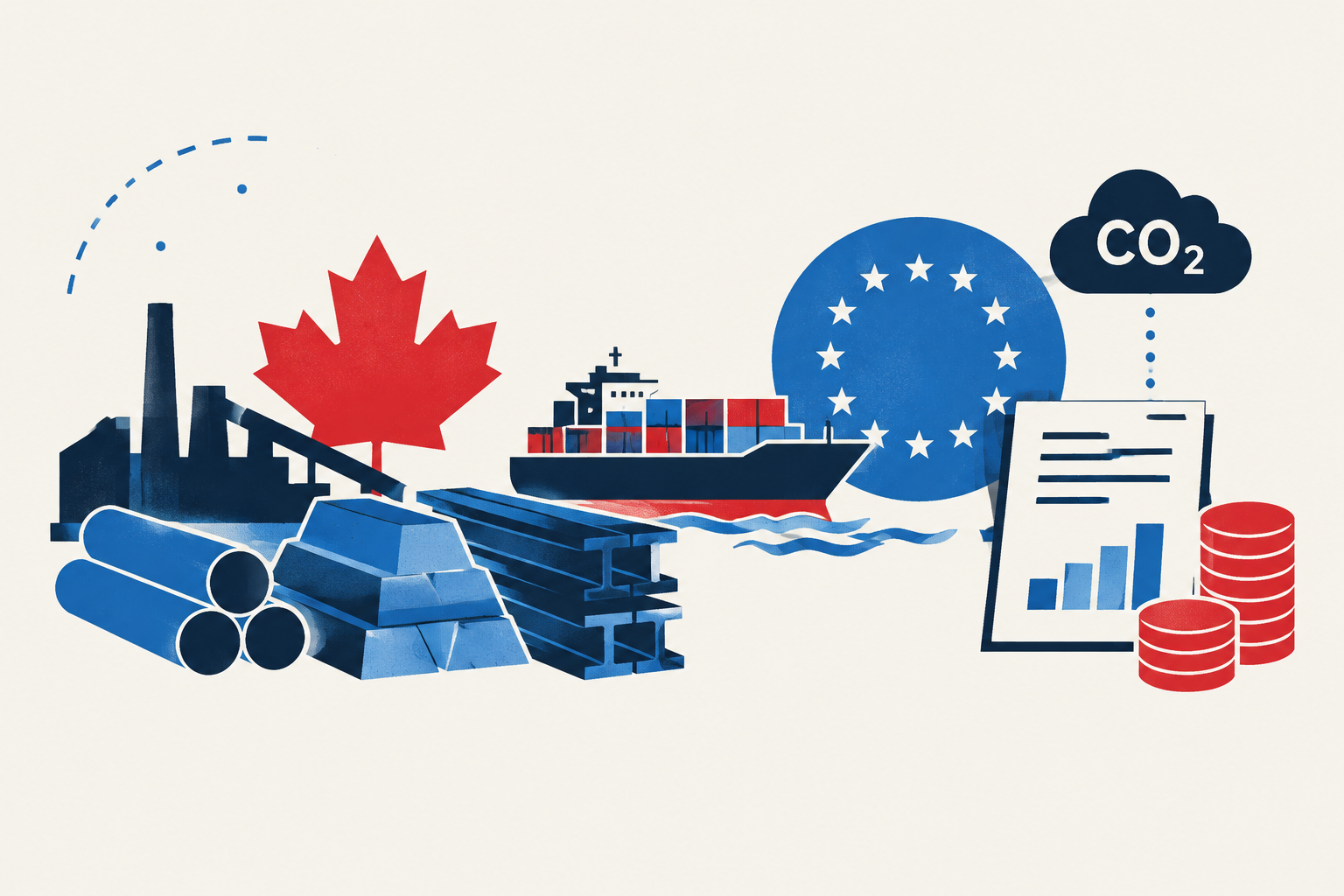
Federal documents put annual exposure to the EU carbon mechanism at $2.8 billion, adding compliance and potential border-charge risk for Canadian metals exporters.
Internal Global Affairs Canada documents obtained by CBC indicate that Canadian iron, steel and aluminum exports will not receive an exemption from the European Union’s Carbon Border Adjustment Mechanism (CBAM), despite Canada’s carbon-pricing system and its trade agreement with the bloc. The federal assessment puts annual Canadian goods exposure at about $2.8 billion as the EU prepares to apply a carbon charge at the border in 2027. [1]
The exposure is concentrated in metals and varies sharply by province. The briefing note estimates that roughly $885 million a year of Newfoundland and Labrador iron and steel exports—nearly half of those exports—could be covered. In Quebec, the annual value of exposed aluminum, iron and steel exports is estimated at about $792 million. Those figures are based on 2021-24 averages, and the documents note that exposure could increase if Canadian suppliers redirect more goods toward Europe to reduce reliance on the U.S. market. [1]
The development adds a prospective European trade-cost issue for an industry already facing U.S. steel and aluminum tariffs. CBAM requires affected exporters to measure the emissions embedded in their goods and have the results verified, creating compliance costs even before the financial effect of the border charge is fully known. Canada’s carbon price may receive some recognition under the EU system, but the documents say an exemption is not currently available because Canada’s system is not linked to the EU carbon market. [1]
Ottawa is seeking to limit the effect on exporters through engagement with the European Commission, including advocacy for recognition of Canadian industrial carbon-pricing arrangements and less burdensome administrative processes. At the same time, the EU’s mechanism is scheduled to phase in gradually through 2034, leaving the eventual product-level cost dependent on emissions profiles, EU rules and how Canadian carbon costs are credited. [1]
The documents characterize Canada’s overall exposure as modest, which limits the immediate economy-wide significance, but the provincial concentration raises the stakes for specific metals-producing regions. Some lower-carbon producers may be better positioned: Canada Nickel told CBC it expects its proposed low-carbon steel-related exports to Europe would face minimal long-run costs, while an expert cited by CBC estimated that fully phased-in CBAM could add about $150 per tonne to Canadian steel. Those outcomes remain assessments rather than realized market effects. [1]
The newly reported federal estimate identifies about $2.8 billion in annual Canadian goods exposure to the EU carbon charge, concentrated in iron, steel and aluminum exports from Newfoundland and Labrador and Quebec. This is significant for metals producers because it combines prospective border costs with verification requirements, but the rating is not higher because the assessment calls total exposure modest, implementation is phased in, and the final burden will vary with emissions and EU recognition of Canadian carbon costs. [1]