Trade expert sees rapid diversification push as Canada pursues China, ASEAN and Philippine arrangements
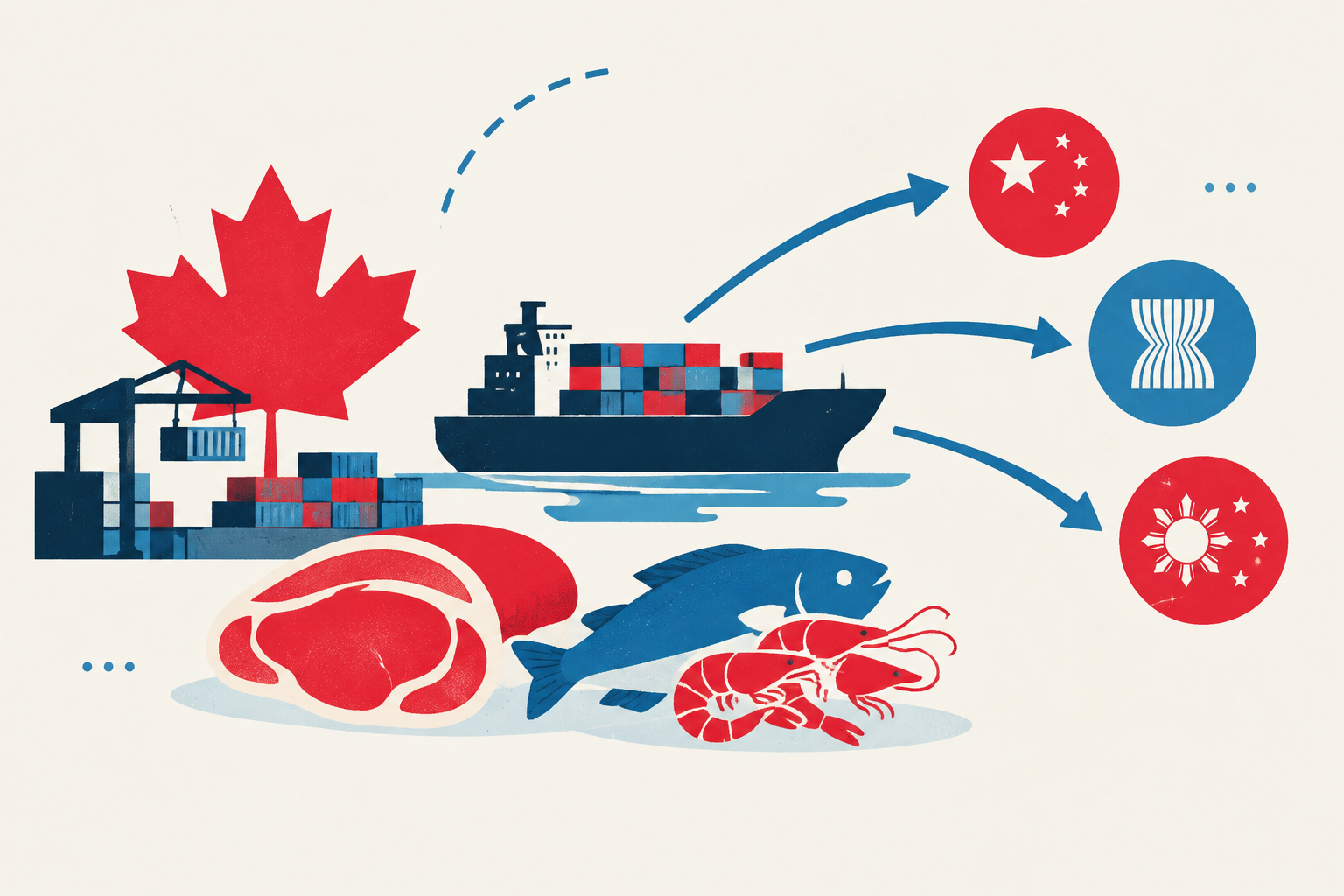
A trade expert says Canada’s accelerated diversification effort may open provisional export opportunities for pork and seafood while leaving businesses without full treaty certainty.
Canada is moving quickly to reduce its dependence on the U.S. market by pursuing trade arrangements with partners in Asia, according to Margaret Kim, international trade counsel at Gowling WLG. Kim told BNN Bloomberg that Canada had concluded agreements with ASEAN counterparts and the Philippines at unusual speed, framing them as part of Ottawa’s response to increasingly complicated Canada-U.S. commercial relations. Her assessment was reported on Nov. 18, 2026, alongside Prime Minister Mark Carney’s meeting with U.S. President Donald Trump at the APEC summit in Shenzhen. [1]
The diversification drive does not replace the importance of the U.S. relationship. A post-meeting readout said Carney and Trump discussed work toward a mutually beneficial trade agreement, while Kim said the two governments’ negotiations had largely occurred outside public view. She characterized the leaders’ face-to-face meeting as encouraging, even as the future form of CUSMA and the broader bilateral relationship remained uncertain. [1]
China is a central part of the current effort. Carney’s trip included an announcement that Canada would remove some restrictions on Chinese steel and aluminum imports in exchange for expanded access for Canadian pork, seafood and other agricultural products. Kim described the tariff relief as a positive development for pork and seafood businesses, identifying those exporters as the clearest immediate commercial beneficiaries cited in the report. [1]
However, Kim cautioned that the Canada-China arrangements are provisional rather than a comprehensive free-trade agreement. That distinction limits the predictability available to firms making longer-term sourcing, sales or investment decisions, despite the potential export opening. She said Canada and China had indicated that further discussions were likely, including possible talks on Chinese-made electric vehicles, but stressed that Canada’s approach would need to fit terms acceptable within the realities of CUSMA. [1]
For agriculture, the development points to a possible additional outlet for pork and seafood exporters at a time when Canada is seeking to broaden market access beyond the United States. It does not establish realized shipment, revenue or price effects, and the source presents the commercial benefit as an expert’s assessment of tariff relief rather than measured sector performance. The discussion of Chinese EVs similarly signals a prospective negotiating issue, not a finalized automotive-market change. [1]
This is a modest industry-impact development because the reported provisional Canada-China tariff relief could directly improve market access for pork and seafood exporters, while Canada’s rapid pursuit of Asian trade arrangements may broaden commercial options beyond the U.S. The significance is limited because the source does not report measured trade, price or production effects, and the expert says the arrangements remain short of a full free-trade agreement that would provide greater business certainty. [1]