U.S. alcohol import ban cuts off Canadian producers as trade dispute escalates
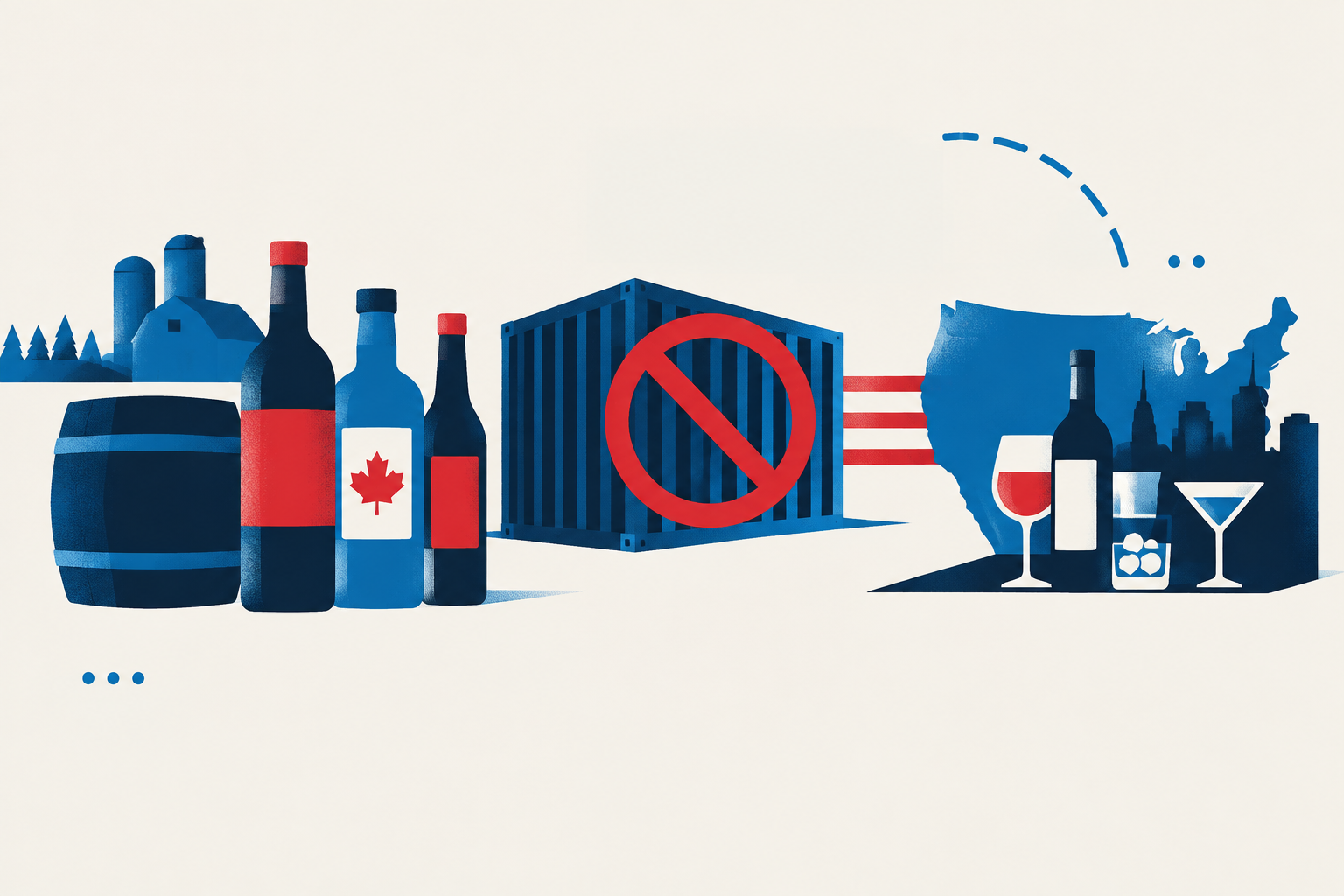
A U.S. import ban now blocks selected Canadian alcohol shipments, interrupting smaller producers’ market access and planned American expansion.
The United States began enforcing import bans at 12:01 a.m. ET on Sept. 29 for certain Canadian goods, including alcohol products, dairy byproducts, motorcycles and molasses. The action prevents covered products from entering the U.S., moving beyond a tariff cost to a direct loss of market access for affected exporters. [1]
For B.C. distiller Sons of Vancouver, the immediate consequence is the end of regular shipments of its wheated rye to U.S. customers. Founder James Lester said the company had been building commercial relationships and seeking to grow in the American market; remaining online inventory in the U.S. is expected to be the last available for an unspecified period. U.S. sales had accounted for less than 10 per cent of the distiller’s overall business, limiting the company-wide exposure while still disrupting its expansion plans. [1]
The hit may be uneven across the alcohol sector. CBC cited U.S. Census Bureau trade data showing that the United States imported US$673 million in Canadian spirits in 2025, compared with US$62.1 million in wine and US$19.2 million in beer. Spirits Canada said the U.S. receives about 93 per cent of Canadian spirits exports, underscoring the sector’s dependence on that destination. [1]
Some larger companies may have more options than independent producers. The ban does not cover barrels of certain liquor above a specified volume, and the U.S. removed tariffs from bulk shipments of certain whiskies and liqueurs when it announced heightened measures earlier in September. A trade lawyer told CBC that multinational companies with bottling or mixing operations on both sides of the border could therefore be relatively better positioned than small breweries, distilleries and vineyards that rely directly on U.S. sales. [1]
Alcohol has remained a politically sensitive part of the bilateral dispute since Canadian provinces removed U.S.-made alcohol from provincial liquor-store shelves in March 2025 following U.S. tariffs on Canada. The White House had previously cited what it described as Canadian discrimination against U.S. alcohol, as well as dairy and autos, in announcing new 50 per cent duties in July. The Sept. 29 import ban adds a more immediate operational constraint for Canadian alcohol exporters than the earlier tariff burden. [1]
This is a limited but concrete business-access disruption: covered Canadian alcohol exporters cannot ship to the U.S., and Sons of Vancouver says the restriction interrupts its planned U.S. growth. The significance remains low because the company said U.S. sales were under 10 per cent of its business, while exemptions for some bulk liquor shipments may cushion larger cross-border operators. [1]