U.S. import bans on Canadian liquor, whey and motorcycles take effect
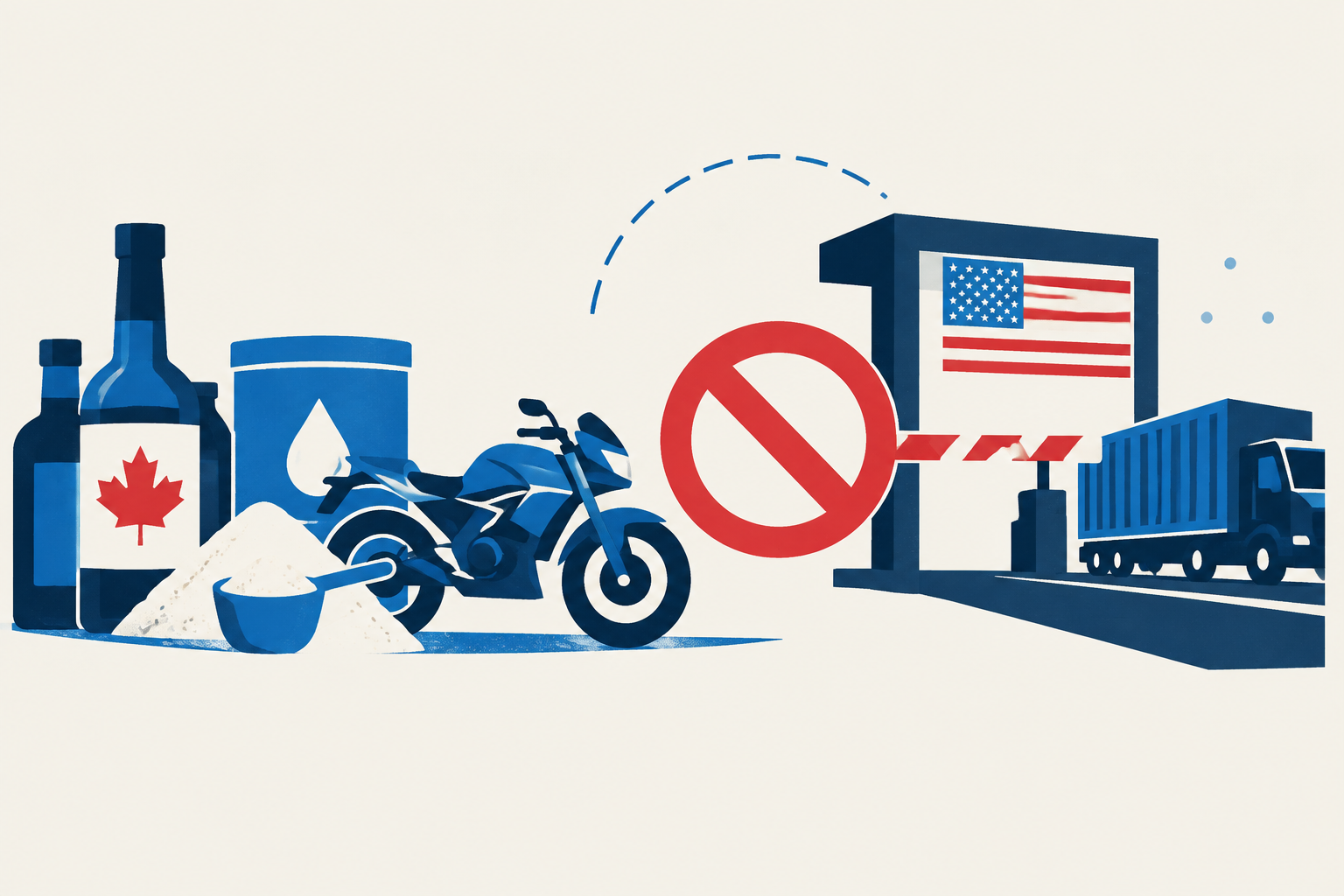
New U.S. bans now block selected Canadian imports, exposing nearly US$1 billion in trade while support expands for affected Ontario businesses.
U.S. import bans covering specified Canadian liquor and spirits, whey, and motorcycles took effect on Sept. 29, adding a new implementation point to the countries’ widening trade dispute. The restrictions are estimated to cover US$967 million in Canadian imports based on 2025 trade, according to Jacob Jensen of the American Action Forum. Alcoholic beverages account for 87 per cent of the covered value. [1]
The alcohol restrictions follow provincial moves to remove U.S. alcohol from store shelves. Toasts Not Tariffs, a U.S. group representing farmers, distillers, retailers, restaurants and bars, said the ban would further draw American hospitality businesses and consumers into a dispute that has already harmed U.S. wine and spirits producers. The group called for a negotiated settlement that would restore cross-border sales. [1]
Motorcycle makers face a more delayed commercial effect. Quebec-based BRP said its three-wheel Can-Am Spyder and Canyon motorcycles will be excluded from importation into the United States, but said most production and shipments for the current season have already been completed. On that basis, BRP expects the principal impact to be felt next year rather than immediately. [1]
The bans arrive after official trade talks broke down in August. The source reports that the United States subsequently imposed 50 per cent tariffs on an array of Canadian goods, followed by Canadian counter-tariffs on similar U.S. products; President Donald Trump then directed agencies to remove Canadian goods from procurement lists and ordered the new import bans. [1]
Ontario expanded access on Tuesday to a $1-billion financing program offering loans to tariff-affected businesses and to a $150-million fund offering grants or loans to small and medium-sized businesses pursuing new markets. The province said the changes are intended both to help firms manage current disruption and to reduce longer-term dependence on a single export market. [1]
Scotiabank's Derek Holt assessed the bans' national economic effect as negligible because Canadian dairy and motorcycle exports to the United States are relatively small. CBC reported that alcohol shipments are the largest covered category, worth about C$1.2 billion last year; individual exporters can still face a severe loss of market access. [2]
This is a significant implementation event because the bans immediately close U.S. import access for named Canadian product lines and are estimated to cover US$967 million in imports, with alcohol representing most of that exposure. The effect is concentrated rather than economy-wide, and BRP expects its motorcycle exposure to emerge mainly next year; Ontario’s expanded financing and market-diversification programs provide some near-term mitigation for eligible businesses. [1]