U.S. spirits exports to Canada fall 70% as provincial alcohol restrictions squeeze Kentucky distillers
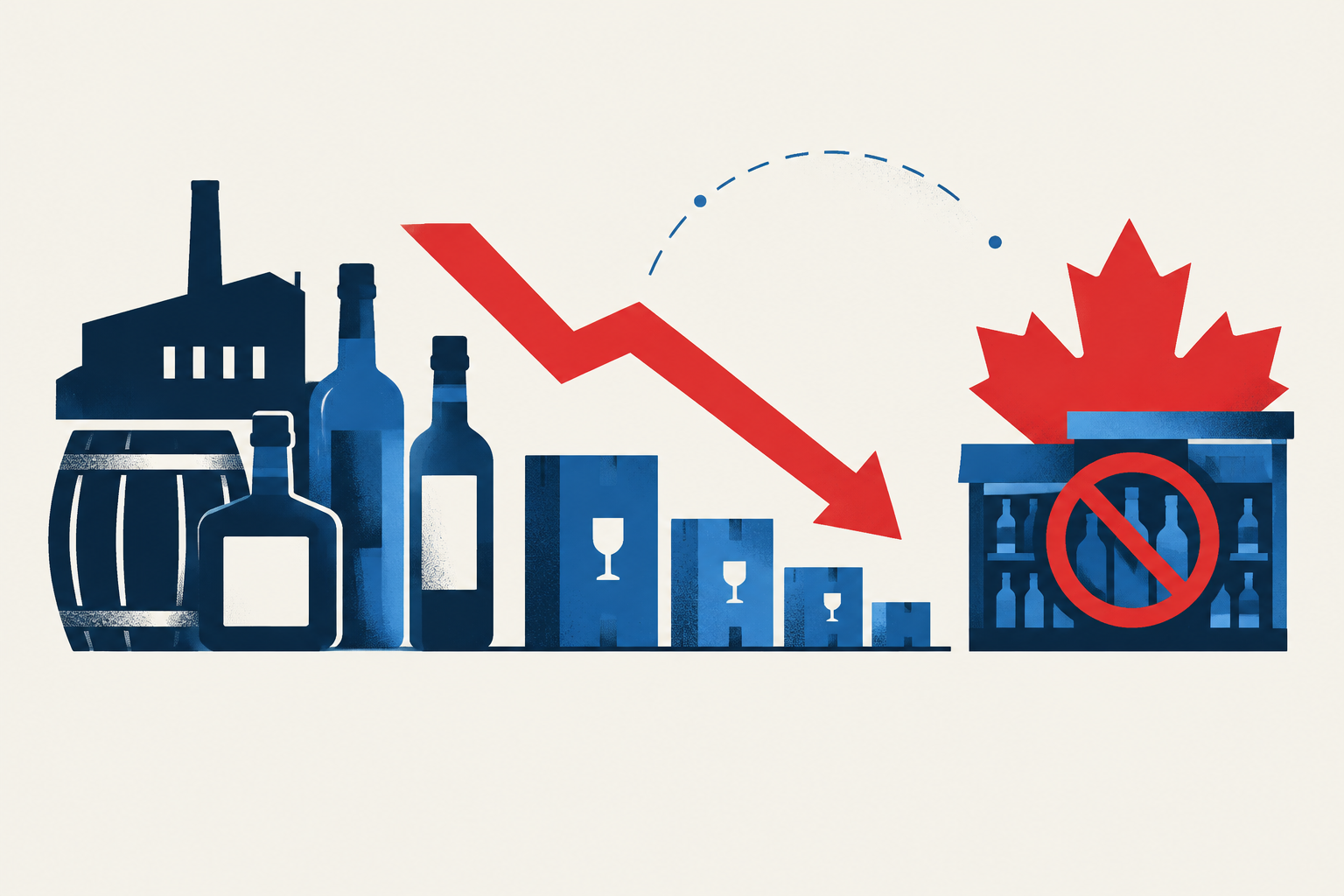
New export figures show Canada’s restrictions sharply reduced U.S. spirits sales, prompting reported hiring freezes and delayed expansion plans at Kentucky producers.
A new assessment of the commercial fallout from Canada’s restrictions on U.S. alcohol puts American spirits exports to Canada at US$72 million annually, down from US$232 million before the bans—a 70% decline, according to the Distilled Spirits Council of the United States as reported by Money.ca. The figures quantify the loss of a major nearby market for U.S. distillers while provincial policies continue to limit the availability of American products in much of Canada. [1]
Kentucky’s flagship spirits segment has also contracted. Data cited from the Kentucky Distillers’ Association show that Kentucky bourbon and whiskey exports to Canada declined 42.4% in 2025, reaching US$25.2 million. Tom Bard, co-founder of The Bard Distillery in Graham, Kentucky, said the loss of Canadian sales forced the business to halt hiring and pause an expansion project; the company opened a tasting room in Bardstown to replace some lost sales. [1]
The restrictions are not uniform across Canada. Alberta and Saskatchewan resumed sales of U.S. alcohol in June 2025, but Money.ca reports that eight other provinces had not restocked the products as of the article’s publication. The report also points to weak demand for U.S. wine in Alberta despite resumed imports, suggesting that restoring shelf access does not necessarily restore prior consumer purchasing patterns. [1]
The alcohol dispute has imposed costs on Canadian provincial systems as well as on U.S. exporters. Ontario prohibited the Liquor Control Board of Ontario from selling existing U.S. inventory, leaving about CA$79 million of products in storage; the LCBO reported roughly CA$8 million in warehousing costs and CA$2.6 million in expired stock. Money.ca also reports that the United States banned imports of most packaged Canadian alcohol on September 29, increasing pressure on Canadian producers that depend heavily on the U.S. market. [1]
For bourbon makers, the reported export decline is evidence of an immediate revenue and investment challenge rather than a complete measure of sector-wide production losses. The available data identify a substantial drop in sales to Canada and one distiller’s operational response, but do not establish how much business has been redirected to other markets or whether the losses will persist if provincial listings and consumer demand recover. [1]
The development is significant because newly reported export data show a 70% decline in U.S. spirits exports to Canada and a 42.4% fall in Kentucky bourbon and whiskey exports, alongside reported hiring and expansion pauses at a Kentucky distillery. The impact is concentrated in alcohol producers and provincial liquor distribution channels, but the rating is not higher because the packet does not provide independently corroborated evidence of broader agricultural-sector conditions or a durable change in trade policy. [1]