U.S. steel supplied majority of Canada’s coated-steel imports, complicating Stelco dumping claim
Federal data show U.S. suppliers led Canada’s coated-steel imports, sharpening scrutiny of claims that overseas dumping is driving Stelco’s layoffs.
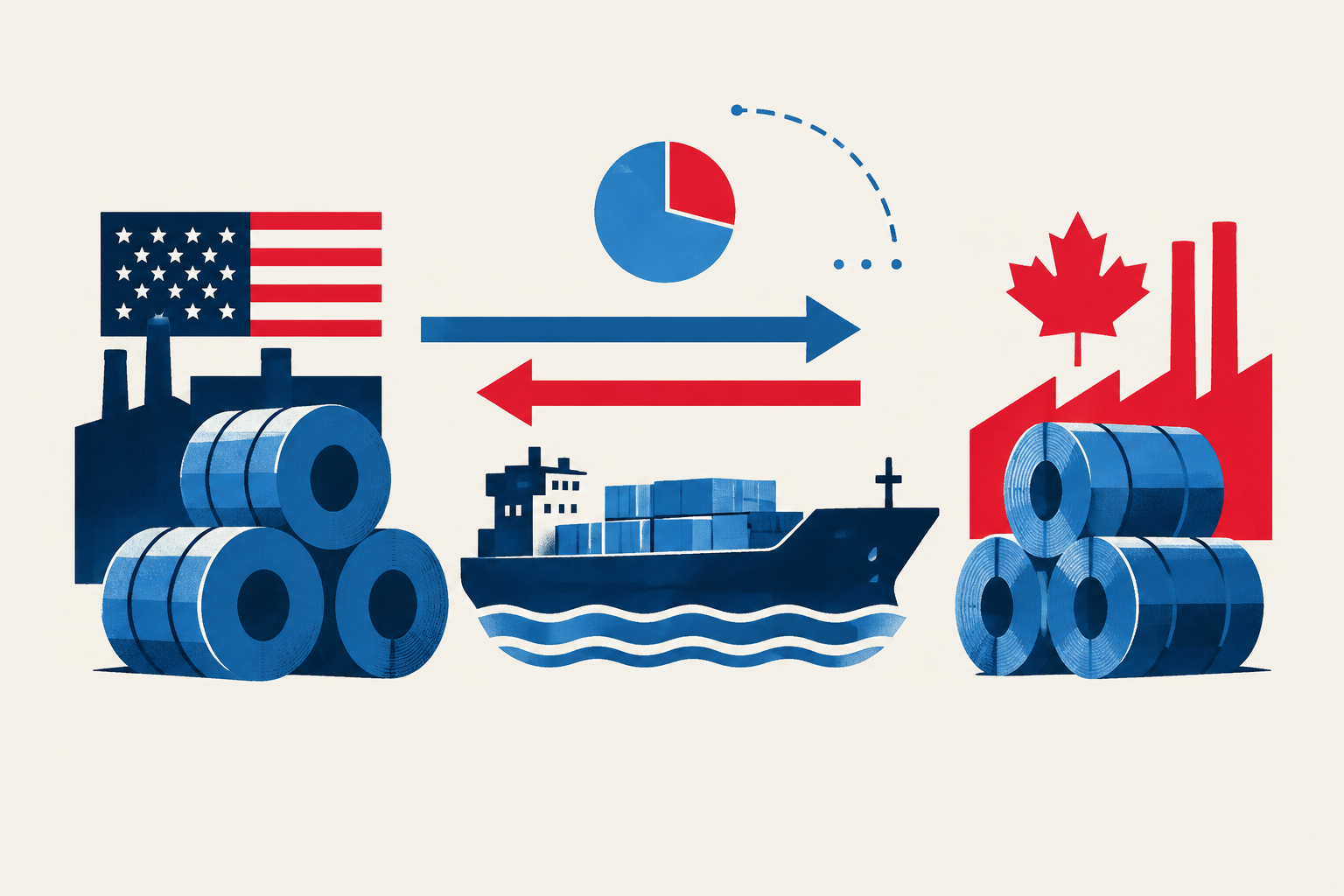
Global Affairs Canada data show that the United States supplied 54.1% of Canada’s 625,726 tonnes of galvanized and coated steel-sheet imports in the first nine months of 2026. The import-source breakdown complicates Cleveland-Cliffs’ contention that low-priced overseas material is a leading explanation for layoffs and the idling of Stelco’s Hamilton, Ontario, operations. [1]
Cleveland-Cliffs has argued that dumped offshore imports and U.S. tariffs have impaired the economics of its Canadian business. In an Oct. 9 letter to Industry Minister Mélanie Joly, Stelco president and general counsel Paul Simon said overseas imports were depressing the market, while acknowledging that Canadian restrictions had reduced some of those inflows. He maintained that the measures had not adequately protected the cold-rolled and coated products made at Hamilton finishing operations. [1]
The trade figures do not establish that imports are harmless for Canadian producers. McMaster University economist Colin Mang said Canada continues to bring in substantial volumes of steel while domestic demand is weakening, adding pressure on producers facing reduced exports to the United States. Mang also said galvanized and coated-steel import prices had increased over recent months, rather than showing the pattern alleged in the company’s dumping argument. [1]
Canada’s import controls differentiate between overseas suppliers and its North American partners. Joly cited tighter quotas introduced in December 2025 in an Oct. 22 response to Stelco, but imports from the United States and Mexico remain outside those restrictions. That structure means a large U.S. share of coated-steel imports is not directly addressed by measures aimed at limiting overseas supply. [1]
For steel buyers and producers, the data shift the immediate policy question from the overall volume of foreign steel toward its origin, pricing and effect on a softer Canadian market. The figures are confined to galvanized and coated sheet over the first nine months of 2026, so they do not on their own settle conditions across other steel categories or determine the causes of Stelco’s operational decisions. [1]
This is a meaningful but bounded steel-market finding: U.S. material accounted for more than half of the reported galvanized and coated-sheet imports, challenging an important part of Stelco owner Cleveland-Cliffs’ explanation for its layoffs. It is not rated higher because the data cover one product grouping and period, and the report still identifies weak demand, continued import volumes and reduced U.S. exports as pressures on domestic producers. [1]