Vermont Cheesemaker Reports Nearly $1M Canadian Sales Loss as Tariff Costs Persist
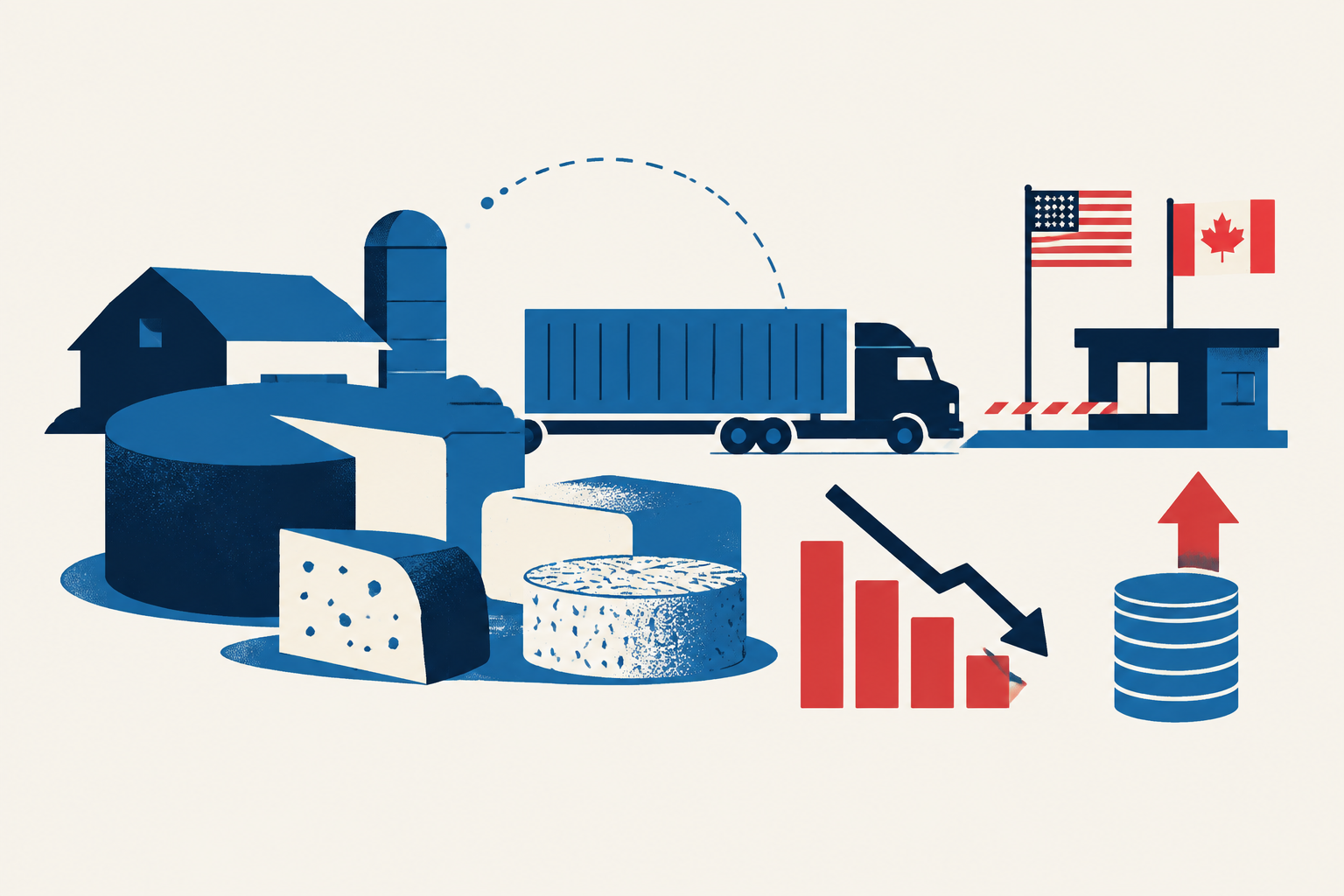
Jasper Hill Farm says lost Canadian cheese sales and higher domestic costs show how tariffs are straining a cross-border specialty-food exporter.
Jasper Hill Farm, a Vermont artisan cheesemaker located about 40 miles from the Canadian border, says the U.S.-Canada trade conflict eliminated what had been its largest export market. Chief executive Mateo Kehler said the company had expected nearly US$1 million in annual cheese sales to Canada, representing roughly 7% to 8% of its annual revenue, but that business disappeared within a month of the tariff escalation in 2025. [1]
The company’s Canadian sales have not recovered even as its wider business has improved in 2026, according to Kehler. He characterized 2025 as Jasper Hill’s worst year, while describing this year’s Canadian revenue as zero. The report frames the lost sales as an 18-month consequence of disrupted cross-border trade rather than a short-lived interruption in orders. [1]
Jasper Hill produces 14 cheese varieties through two creameries in Vermont’s Northeast Kingdom, including a raw-milk operation in Greensboro and a pasteurized-cheese operation in Hardwick. Its business model is built around premium cheese and partner dairy farms; Kehler said the company’s higher-value production enables it to pay those farms three times what they would receive in commodity markets. That structure may make a sudden export-market loss especially consequential for the company and its supplying farms, although the report does not quantify farm-level effects. [1]
The sales disruption followed U.S. tariffs announced in February 2025 on most Canadian imports and Canada’s retaliatory tariffs on U.S. goods, according to the report. Kehler also said tariffs continue to raise Jasper Hill’s domestic operating costs, indicating that the impact is not confined to sales into Canada. The source does not specify the individual inputs affected, the amount of the cost increase, or whether Jasper Hill has changed prices, sourcing, staffing, or production in response. [1]
For Canada-U.S. trade watchers, the case provides a company-level illustration of exposure in specialty food commerce: a geographically proximate export customer base can disappear quickly when retaliatory measures affect goods moving in both directions. It does not establish conditions across the wider dairy or agriculture sector, but it adds evidence of pressure on a U.S. exporter that had relied on Canadian demand and now faces higher costs at home. [1]
This is a meaningful but company-specific business-impact report: Jasper Hill Farm says tariffs erased nearly US$1 million in expected annual Canadian sales, or 7% to 8% of revenue, and continue to raise operating costs. The report signals exposure for cross-border specialty-food suppliers and linked dairy farms, but a single company account without quantified sector-wide effects does not justify a broader agriculture forecast change. [1]