Whey price spike puts protein products in trade-dispute crossfire
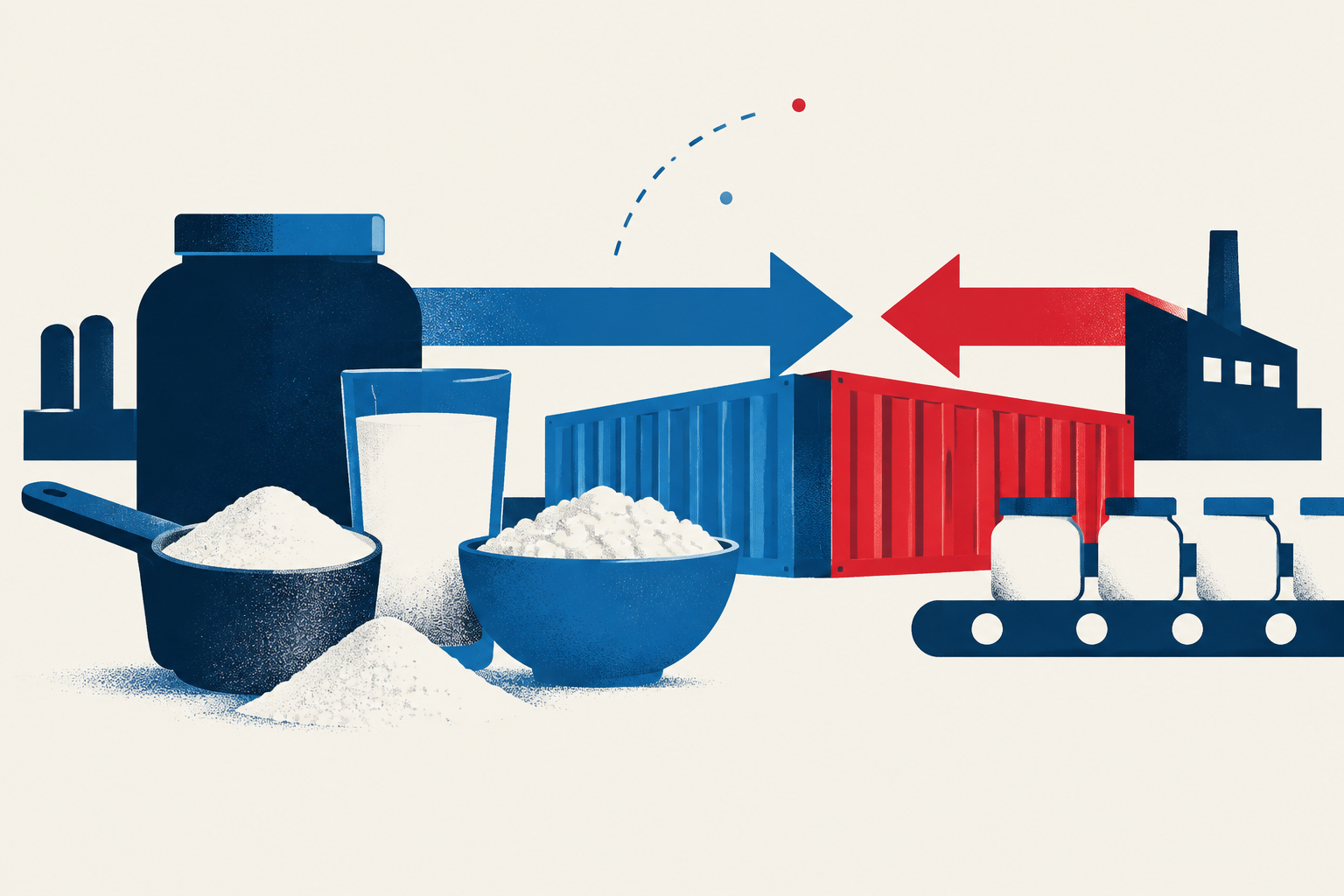
Record U.S. whey concentrate prices and new cross-border restrictions are raising cost and supply risks for protein-product makers.
A new report on the dairy trade dispute points to a sharp wholesale warning signal for businesses using whey: U.S. whey-protein concentrate reached a record US$13 per pound in June, roughly 250% above its level a year earlier, according to USDA data cited by the report. Prices subsequently eased to about US$10-US$11 per pound, but manufacturers say the earlier increase has not yet been fully reflected in consumer pricing. [1]
The reported pressure comes as the United States is scheduled to prohibit imports of several Canadian dairy products, including certain whey products, from September 29. Canada, meanwhile, has listed whey-protein concentrate and several powdered-whey products among U.S. imports subject to a 50% counter-tariff. The measures affect an ingredient used in protein powders, ready-to-drink shakes, snack products and other high-protein foods. [1]
For Canadian manufacturers, substituting supply may be difficult rather than immediate. The report says Canada has less cheese production than the United States and fewer facilities able to process whey into the concentrated forms used by protein-product manufacturers. Alternative proteins such as pea protein may not face the same tariff exposure, but changing formulations can require recipe, production-process and supply-chain adjustments. A British Columbia manufacturer told CNN, as cited by Livemint, that its business depends on U.S. suppliers for highly processed whey that is available in limited supply in Canada. [1]
The immediate commercial consequence is a risk of higher ingredient costs and tighter sourcing options, not a confirmed, uniform retail-price increase. Canadian processors and food manufacturers appear most exposed to supply disruption because of their reliance on U.S. whey, while U.S. consumers may face higher prices if elevated wholesale costs move through to finished products. The report frames these effects as prospective, with manufacturers warning that consumer prices have yet to absorb the full wholesale increase. [1]
This is a specialized agriculture and food-manufacturing exposure within the broader bilateral dispute. The source also reports a U.S. ban covering selected Canadian dairy products, alcohol and motorcycles from September 29, alongside Canadian retaliatory tariffs on roughly US$20 billion of U.S. goods earlier in the month. For whey-dependent businesses, the main operational issue is whether they can preserve product availability and formulations while cross-border access and tariff costs remain uncertain. [1]
The development adds a concrete price indicator to the whey-supply disruption: U.S. whey-protein concentrate hit US$13 per pound in June, about 250% above a year earlier, before easing to US$10-US$11. It matters most to dairy-adjacent food manufacturers and protein-product brands that rely on concentrated U.S. whey, but the rating is not raised because the source reports prospective pass-through and supply concerns rather than verified broad retail-price effects or production losses. [1]