CNN charts broader Canada-U.S. trade fallout as export diversification accelerates
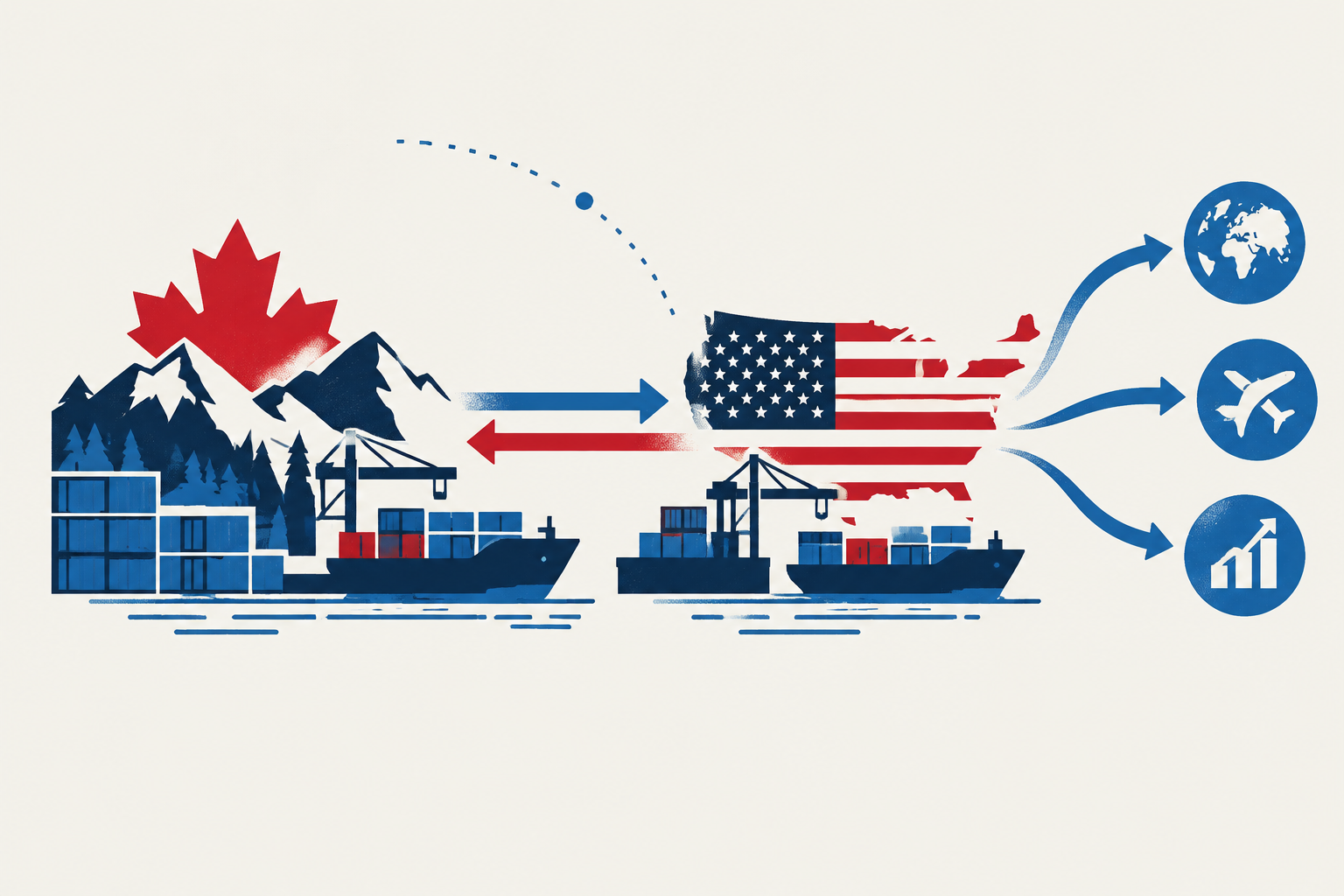
New reporting links the trade dispute to weaker bilateral commerce, reduced Canadian dependence on the U.S. market and visible spillovers into travel and investment.
CNN’s October 30 reporting presents the Canada-U.S. trade conflict as an economy-wide rupture rather than a dispute confined to individual tariff lines. It says the total value of bilateral trade has been declining since 2022, with the largest annual drop over that period occurring last year, when the United States imposed 50% tariffs on steel and aluminum. The network also reports that summer U.S. duties on roughly US$20 billion in Canadian goods, alongside Canadian matching measures, are expected to add further pressure to cross-border trade. [1]
The most consequential longer-term shift identified in the report is in Canada’s export orientation. The United States remains Canada’s dominant foreign market, but Global Affairs Canada’s Office of the Chief Economist found that the U.S. share of Canadian exports fell sharply after President Donald Trump returned to office, amid greater trade uncertainty. CNN says Canada increased exports to Europe and Central Asia during the same period as businesses and policymakers sought to reduce exposure to the U.S. market. [1]
That diversification push is now being paired with a prospective Canada-EU economic initiative. Prime Minister Mark Carney has pursued an associate-membership arrangement with the European Union and, with European Commission President Ursula von der Leyen, invited other countries to an “Alliance for the Future.” CNN notes that the form and viability of an EU-Canada association remain uncertain, with opposition reported from officials in Germany and France as well as criticism within Canada. [1]
Alcohol illustrates how trade actions can quickly affect highly visible consumer categories even where their overall contribution to bilateral commerce is limited. After provincial liquor boards removed U.S. products in March 2025, American spirits exports to Canada fell to US$9.7 million in the second quarter of 2025, then recovered to more than US$20 million in each of the following two quarters, according to the Distilled Spirits Council figures cited by CNN. The report adds that the United States subsequently banned most Canadian liquor shipments. [1]
The reporting also identifies effects outside merchandise trade. Statistics Canada data cited by CNN show Canadian visits to the United States fell to 29.1 million in 2025, while Canadian spending in the U.S. declined by C$2.7 billion from 2024. Canadian investors later sold a record C$31 billion of U.S. stocks in July 2026 after having invested heavily in the first half of the year, with sales concentrated in large U.S. technology companies. These indicators do not establish a permanent break in commercial ties, but they point to trade tensions influencing tourism and capital flows as well as goods trade. [1]
This is significant because CNN’s new October 30 assessment connects tariff escalation and retaliation with broader reported changes in bilateral trade, Canadian export-market diversification, alcohol flows, cross-border travel and investment. The evidence signals widening exposure across the two economies, but the rating is not higher because the report describes trends and expected effects rather than providing a new verified sector-wide tariff action or confirmed economy-wide outcome attributable solely to the latest measures. [1]