Canada’s 2025 GDP Growth Reached 1.9% as Household Spending Offset Weaker Trade
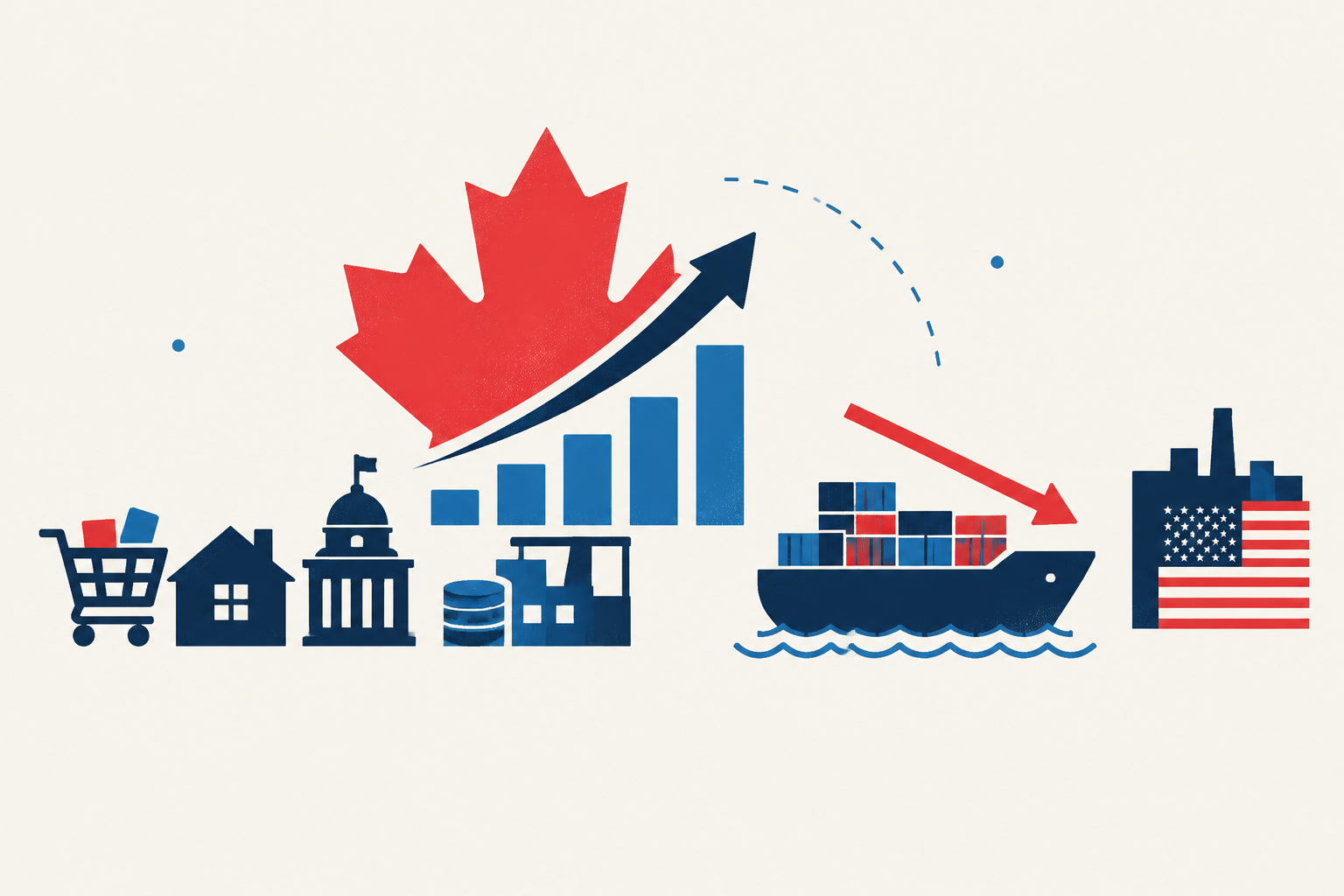
Annual growth slowed as consumer spending, government outlays and investment offset declining international trade, leaving exporters exposed to a softer external backdrop.
Statistics Canada reported that real GDP rose 1.9% in 2025, following 2.1% growth in 2024. Household final consumption was the largest contributor to the annual increase, with government final expenditure and capital investment also adding to growth. Lower goods exports and withdrawals from non-farm business inventories constrained the overall result. [1]
Household spending increased 2.0% in 2025, its slowest expansion since the pandemic-related decline in 2020. Financial services and rent were among the main sources of growth, while spending on education declined alongside fewer international students. Canadian spending abroad also weakened as travel to the United States slowed, indicating a trade-linked reduction in cross-border consumer activity. [1]
International exports fell 1.1% during 2025, led by reduced shipments of intermediate metal products, particularly unwrought gold, as well as building and packaging materials and industrial machinery and equipment. Imports declined 0.4%, reflecting lower purchases of motor vehicles and parts, unwrought gold, and industrial machinery and equipment. Statistics Canada said global uncertainty and tariff imposition contributed to reduced international trade, particularly with the United States. [1]
The weaker international trade picture was not uniform across regions or products. Newfoundland and Labrador posted a 10.3% increase in international exports, driven by crude-oil shipments, while Nunavut and the Northwest Territories recorded the largest export declines, associated respectively with metal ores and diamonds. At the same time, internal trade increased as a share of total trade in every province and territory except Newfoundland and Labrador and Yukon, suggesting a broader shift toward domestic commerce amid external uncertainty. [1]
Investment data showed a mixed business backdrop. Capital spending rose 1.6%, with government engineering and non-residential construction a principal driver, while business investment in engineering structures increased 3.4%. However, machinery and equipment investment declined for a second consecutive year, including drops in industrial machinery and equipment and aircraft and other transportation equipment; investment in computers and peripherals increased 14.1%. [1]
For trade-exposed businesses, the release points to a slower-growth environment in which domestic demand and public-sector activity supported the aggregate economy but did not prevent an annual contraction in cross-border goods trade. The data do not isolate the impact of any individual tariff measure or establish sector-specific effects, but they underscore that international exports were a drag on 2025 growth. [1]
This is a significant economy-wide annual measurement because it confirms that Canada’s 2025 expansion slowed to 1.9% and that international exports declined 1.1% amid trade uncertainty, despite support from household consumption, government expenditure and capital investment. The result matters for trade-exposed firms, but the rating is not higher because the release does not attribute outcomes to a specific trade measure or provide independently corroborated evidence of a material change in any dashboard industry forecast. [1]