Canadian firms seek supply and export alternatives as confidence in North American trade falls
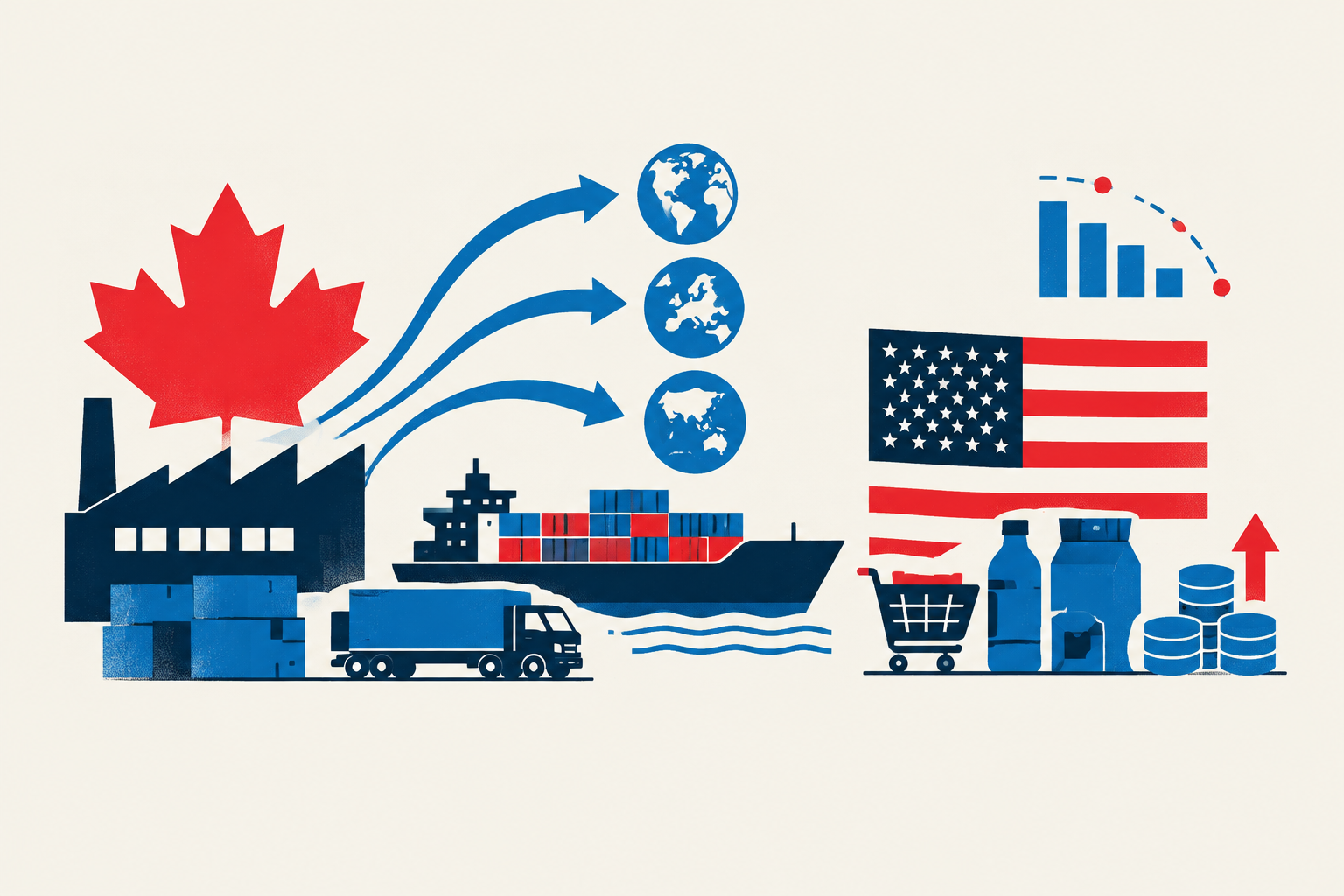
A new business survey points to broad Canadian supply-chain diversification and consumer cost pass-through amid weaker confidence in regional trade stability.
A Livingston International-commissioned survey released October 29 found a pronounced gap in confidence about North American trade conditions: 25% of Canadian businesses said they lack confidence in the region’s stability over the next five years, compared with 8% of U.S. businesses. The findings come from an online survey of companies in Canada and the United States across 12 industries, conducted from August 20 to September 9, 2026. [1]
The reported response is not limited to sentiment. Nine in 10 Canadian importers said they are considering suppliers other than those they currently use, with interest focused beyond North America, including Asia, the EU and UK, and Central and South America. On the sales side, 85% of Canadian exporters are considering alternative markets as they confront added trade costs and administrative complexity associated with tariffs, countermeasures and regulatory change. [1]
Asia was identified as a key alternative export destination by 82% of Canadian respondents, while 58% cited the EU and UK and 50% cited Central and South America. The survey also suggests Canadian firms are less inclined than U.S. firms to bring production from outside North America back onto the continent: 68% of Canadian businesses indicated that preference, compared with 84% in the United States. These results indicate that diversification planning is extending across both sourcing and market-access decisions rather than being confined to individual imports. [1]
Cost transmission remains a central near-term business consequence. The survey found that 64% of Canadian businesses are passing some or all costs from tariffs, surtaxes and other trade disruption to consumers, while 20% are absorbing the full cost. Only 14% reported being minimally affected or unaffected by shifting trade policies. Respondents also reported operational strain around customs compliance, with 63% of Canadian businesses saying they were only somewhat prepared or ill-prepared for policy changes and had difficulty validating compliance. [1]
The findings should be read as a commissioned survey of business views and intended responses, rather than a measure of completed supplier shifts, realized export rerouting or economy-wide price effects. Still, the breadth of respondents reporting diversification and cost pass-through shows that trade-policy volatility is influencing commercial planning across industries. The survey’s results also underscore why the continued usability of CUSMA/USMCA matters to firms: although most Canadian respondents use the agreement, only one quarter identified it as a source of confidence in the North American trading environment. [1]
This is a moderate-significance business-impact development because the survey reports broad, newly measured pressure on Canadian firms: lower confidence than U.S. peers, active consideration of alternative suppliers and export markets, and widespread pass-through of trade-disruption costs. The rating is not higher because the source reports survey responses and planned actions across industries, not verified sector-specific changes in trade flows, prices or production. [1]