Analysis maps $188B Canada trade exposure across competitive U.S. Senate states
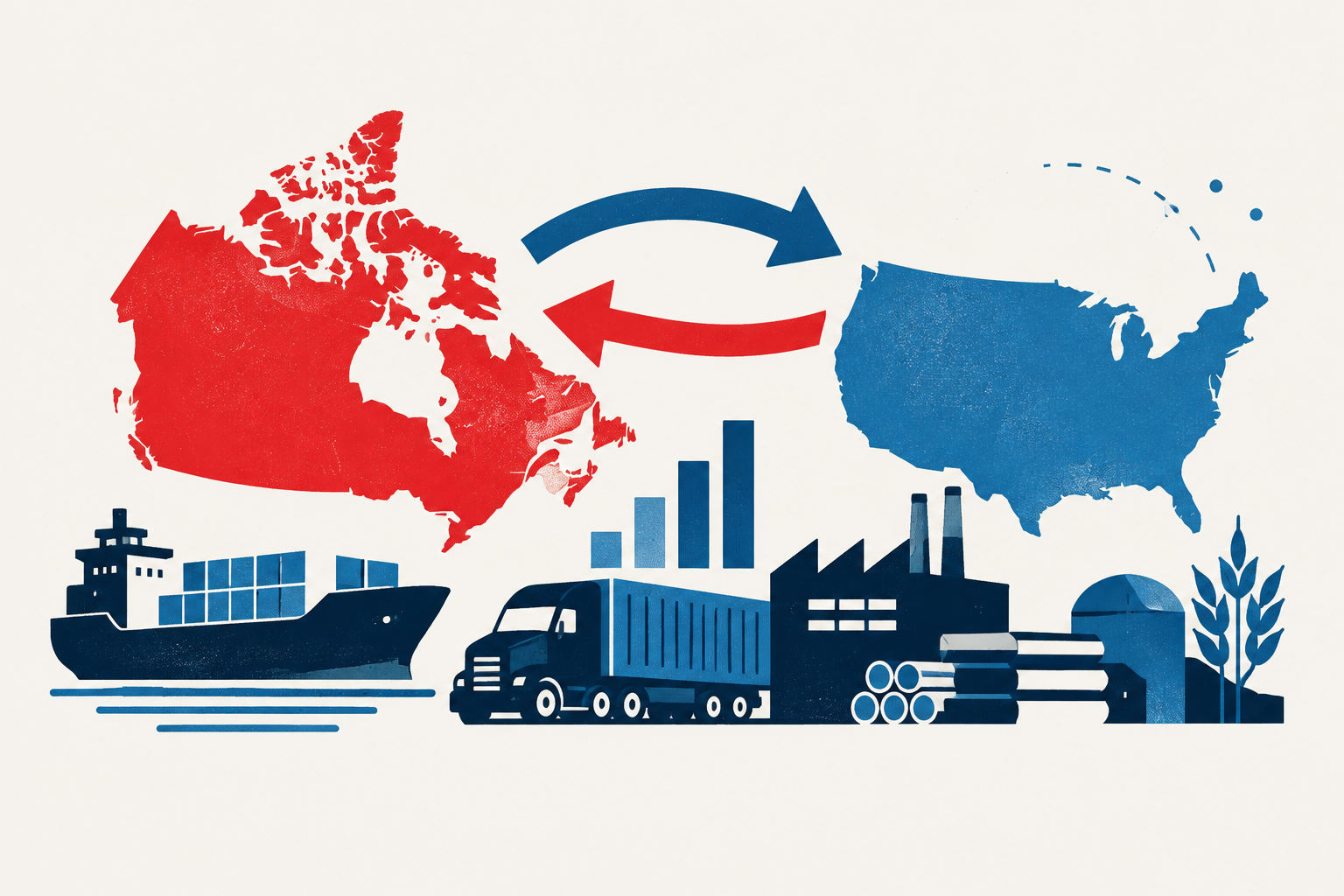
A new state-level analysis highlights concentrated Canada trade exposure in battleground states, sharpening the business stakes of continuing tariffs and retaliation.
An Advancing American Freedom Foundation analysis reported on Sept. 28 found that Iowa, Maine, Michigan, New Hampshire, Ohio and Texas conducted a combined $188 billion in commerce with Canada during the 12 months through June 2026. The total represented more than one-quarter of the $674 billion in annual bilateral trade cited in the analysis, placing substantial cross-border commercial activity in states with closely watched Senate contests. [1]
The analysis also identified high relative dependence on Canadian goods trade in several northern and Midwestern states. Canada accounted for 62% of Maine’s annual goods trade, 30% of Minnesota’s, 29% each in Iowa and Michigan, 23% in Ohio and 16% in New Hampshire over the same period. Those figures do not measure tariff costs directly, but they indicate where disruptions to Canada-linked supply chains and customer relationships could carry greater local business exposure. [1]
The findings arrive against a backdrop of reciprocal tariff actions. The report said Canada earlier in September imposed retaliatory tariffs of 15% to 50% on more than $20 billion of U.S. products, including steel, aluminum, wool, lumber, milk, T-shirts and air conditioners. It also said the United States imposed 50% duties on an estimated $28 billion of Canadian goods on Aug. 22, including beer, cheese and electronics, and later barred Canadian products from federal contracts. [1]
The sectoral exposure described in the analysis spans agricultural regions, heavy-industry locations, and energy- and mineral-producing states. The foundation said a trade conflict with Canada could adversely affect states with strong connections to energy and minerals, heavy industry and agriculture; however, the reporting provides an exposure map rather than verified evidence of new sector-wide production, employment or price outcomes. [1]
For Canadian exporters and U.S. buyers, the immediate implication is that trade-policy uncertainty is now paired with quantified evidence of where bilateral commerce is concentrated. Maine, Iowa, Michigan, Ohio and New Hampshire combine high or double-digit Canadian trade reliance with politically salient Senate races, while Texas contributes to the six-state group’s large aggregate commerce total. [1]
This is a moderate-significance industry-impact development because it supplies new, quantified evidence that $188 billion of Canada-linked commerce is concentrated in six competitive Senate states, with especially high goods-trade reliance in Maine and notable exposure across Midwestern states. It broadens visibility into affected agricultural, industrial, forestry and energy-linked regions, but the analysis does not establish new tariff terms or verified changes in sector output, prices or employment, limiting the rating. [1]